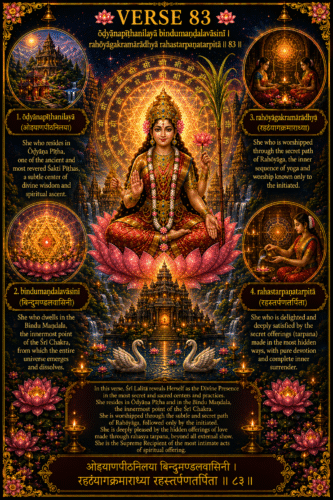
83
Sanskrit:
ओड्याणपीठनिलया बिन्दुमण्डलवासिनी ।
रहोयागक्रमाराध्या रहस्तर्पणतर्पिता ॥ ८३ ॥
English:
ōḍyāṇapīṭhanilayā bindumaṇḍalavāsinī |
rahōyāgakramārādhyā rahastarpaṇatarpitā ॥ 83 ॥
Tamil:
ஓட்³யாணபீட²நிலையா பி³ந்து³மண்ட³லவாஸினீ ।
ரஹோயாக³க்ரமாராத்⁴யா ரஹஸ்தர்பணதர்பிதா ॥ 83 ॥
Meaning:
This verse marks a subtle yet profound turning point in the spiritual journey of the Sahasranāma. Having revealed the Divine Mother as the fullness of Divine Love, it now invites the seeker into the inner sanctuary of worship.
The verse begins by placing Her in Ōḍyāṇa Pīṭha, a sacred seat of Divine Power, and immediately leads us deeper to Bindumaṇḍalavāsinī, where She is revealed as dwelling in the Bindu—the mystical centre of the Śrīcakra. The journey is intentional: from the outer sacred place to the innermost point of divine realization.
The remaining names shift the emphasis from external ritual to inner transformation. The Divine Mother is worshipped through Rahōyāga, the inward sacrifice performed with purity, awareness, and devotion. She is pleased not by elaborate ceremonies alone, but by the silent offering of an awakened heart.
Together, these four names gently teach that while sacred places and sacred rituals have their place, their true purpose is to guide the seeker toward the innermost presence of the Divine, where worship becomes an intimate communion between the soul and the Mother.
Meditation:
This verse gently turns our attention from the outer shrine to the inner shrine of the heart.
We naturally begin our spiritual journey by visiting temples, sacred places, and holy pilgrimage sites. The Divine Mother lovingly accepts this outward worship, yet She gradually leads us toward a deeper realization—that the holiest sanctuary is the one awakened within.
Meditate upon Ōḍyāṇapīṭhanilayā and reflect that every sacred place on earth is a reminder of the sacredness that lies hidden within ourselves. Pilgrimage purifies the mind, preparing it for the inward journey.
Contemplate Bindumaṇḍalavāsinī and visualize the radiant Bindu at the heart of the Śrīcakra. Though it appears as a single point, it symbolizes the Infinite—the still centre from which the universe arises and into which it dissolves. In the language of the Upaniṣads, the One without a second is discovered not through distance but through inward realization.
Reflect upon Rahōyāgakramārādhyā and understand that the deepest worship often unfolds in silence. When the mind becomes still, every breath becomes a mantra, every thought an offering, and every moment an act of worship. The outer ritual finds its fulfilment in inner awareness.
Finally, meditate upon Rahastarpaṇatarpitā. The Divine Mother is pleased not by the grandeur of what is offered but by the purity of the heart that offers it. A silent prayer, a tear of gratitude, a moment of complete surrender, or a heart filled with love becomes the most sacred oblation.
May every visit to a temple remind us of the temple within, until the heart itself becomes the Bindu, the living abode of Śrī Lalitā.
Sanskrit: ओड्यान-पीठ-निलया
Tamil: ஓட்³யாண-பீட²-நிலையா
Meaning: She who resides in the sacred Oḍyāṇa Pīṭha, one of the most revered seats of Śrīvidyā worship. ஒட்யாணம் எனும் பரம புனித சக்தி பீடத்தில் நித்தியமாக உறைந்து அருள்புரிபவள் . சிரமங்கள் மறைந்துவிடும் என்று மட்டும் சொல்லவில்லை; அவற்றைக் கடக்க இறையருள் நம்மை வழிநடத்தும் என்பதை உணர்த்துகிறது.
Reflection: She is the Divine Mother who eternally dwells in the sacred seat of spiritual awakening. She reminds me that true pilgrimage is not merely reaching a holy place, but awakening the sacred presence within my own heart. Where devotion becomes experience, there She already resides.
Contemporary Reflection: She teaches that every home, workplace, or quiet corner can become a sacred space when approached with reverence and awareness. Through sincere intention, even ordinary moments become opportunities to experience the Divine.
Meditation: As I sit quietly, I imagine my heart becoming a radiant temple where the Divine Mother eternally resides. In Her silent presence, every fear, burden, and worry begins to lose its hold. I feel Her gently guiding me across the river of life's challenges, carrying me toward peace, hope, and the quiet certainty that I am never alone under Her loving protection.
Sanskrit: बिन्दुमण्डल-वासिनी
Tamil: பி³ந்து³மண்ட³ல-வாஸினீ
Meaning: She who dwells in the Bindu, the central point of the Śrīcakra. ஸ்ரீசக்ரத்தின் மையமாகிய பிந்து மண்டலத்தில் நித்தியமாக உறைந்து அருள்புரிபவள்
Reflection: She is the Divine Mother who eternally abides in the Bindu, the supreme center of the Śrīcakra—the point from which the entire universe emerges and into which all creation finally returns. She reminds me that beneath the countless movements of life there exists an unchanging center of peace, consciousness, and divine presence. By turning inward, I discover that sacred center within my own heart.
Contemporary Reflection: She teaches that while life constantly pulls us in many directions, inner stability comes from remaining centered. When we return to silence, clarity, and self-awareness, our decisions become wiser and our lives more peaceful.
Meditation: As I sit quietly, I visualize a radiant point of brilliant light shining in the center of my heart. Though it appears as a tiny bindu, I feel it containing infinite peace, wisdom, and love. I gently rest my awareness in that sacred center where the Divine Mother silently resides. Every distraction fades away, and I experience the stillness from which all thoughts arise and into which they peacefully dissolve.
Sanskrit: रहोयाग-क्रमाराध्या
Tamil: ரஹோயாக³-க்ரமாராத்⁴யா
Meaning: She who is worshipped through the secret and inward forms of sacred worship. ரகசியமான உள்ளார்ந்த யாக முறைகளால் ஆராதிக்கப்படுபவள்
Reflection: She is the Divine Mother who is adored through the subtle disciplines of inner worship (Antar Yāga). She teaches me that the highest offering is not made with external materials, but with purified thoughts, selfless love, and unwavering awareness. Every sincere act of inner surrender becomes an offering into the sacred fire of wisdom.
Contemporary Reflection: She reminds us that true spirituality is cultivated in the quiet moments when no one is watching. Every compassionate thought, every honest action, and every moment of self-reflection becomes an inner act of worship that transforms our lives from within.
Meditation: As I sit quietly, I imagine my heart as a sacred altar and my awareness as a gentle flame. Into that inner fire I offer my fears, ego, attachments, and restless thoughts. In their place, I offer love, gratitude, and surrender to the Divine Mother. As the silent yajña continues within, I feel Her presence filling my heart with purity, wisdom, and profound peace.
Sanskrit: रहस्तर्पण-तर्पिता
Tamil: ரஹஸ்தர்ப்பண-தர்ப்பிதா
Meaning: She who is pleased by secret offerings and inner acts of devotion. ரகசியமான, உள்ளார்ந்த அர்ப்பணிப்புகளால் திருப்தியடையும் பரம தாயானவள்
Reflection: She is the Divine Mother who delights in the hidden offerings of a sincere heart. She teaches me that the purest worship is not performed for the world to see, but offered quietly with love, humility, and complete surrender. Every silent prayer and every selfless act becomes an offering that reaches Her directly.
Contemporary Reflection: She reminds us that genuine goodness needs no audience. Acts of kindness performed without seeking praise, silent prayers offered with faith, and humble service rendered with love possess immense spiritual value and quietly transform both the giver and the receiver.
Meditation: As I sit quietly, I offer the Divine Mother my gratitude, my hopes, my fears, and even the words I cannot express. I seek nothing in return except the joy of placing everything at Her feet. In the silence of my heart, I feel Her lovingly accepting these unseen offerings, filling me with quiet contentment and the peace that comes from complete surrender.
Audio courtesy of The Sanskrit Channel
Video courtesy of Sri Sankara TV YouTube channel