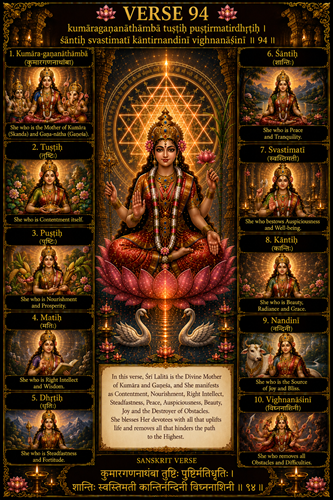
94
Sanskrit:
कुमारगणनाथाम्बा तुष्टिः पुष्टिर्मतिर्धृतिः ।
शान्तिः स्वस्तिमती कान्तिर्नन्दिनी विघ्ननाशिनी ॥ ९४ ॥
English:
kumāragaṇanāthāmbā tuṣṭiḥ puṣṭirmatirdhr̥tiḥ |
śāntiḥ svastimatī kāntirnandinī vighnanāśinī ॥ 94 ॥
Tamil:
குமாரக³ணநாதா²ம்பா³ துஷ்டி꞉ புஷ்டிர்மதிர்த்⁴ருதி꞉ ।
ஶாந்தி꞉ ஸ்வஸ்திமதீ காந்திர்நந்தி³நீ விக்⁴நநாஶிநீ ॥ 94 ॥
Meaning:
Verse 94 presents Śrī Lalitā as a complete movement from the Motherhood that unites wisdom and courage into the inner conditions that allow a seeker to flourish, think clearly, persevere, rest in peace, live auspiciously, radiate goodness, experience wholesome joy, and move beyond obstacles.
The opening Kumāragaṇanāthāmbā gives the governing image: the Divine Mother is the source of both Gaṇeśa’s wisdom and Skanda’s valor. Wisdom and strength are not competing powers; they are complementary expressions of Her motherhood. The verse then turns inward, showing what becomes possible when these qualities are integrated.
Tuṣṭiḥ and Puṣṭiḥ establish fullness at two closely related levels. Tuṣṭiḥ is the inward contentment that recognizes enough; Puṣṭiḥ is the nourishment and flourishing through which body, heart, understanding, and spiritual life are sustained. Together they move the seeker from restless acquisition toward wholesome abundance.
Matiḥ and Dhṛtiḥ then transform fullness into a way of living. Matiḥ gives clarity, discernment, memory, and wise understanding; Dhṛtiḥ gives the steadiness to remain aligned with what one understands even after initial enthusiasm fades. Knowledge therefore becomes sustained action rather than merely accumulated information.
Śāntiḥ follows naturally: when unnecessary desire and inner restlessness diminish, the mind becomes quieter and clearer. Svastimatī then expresses this clarity as auspicious, integrated well-being—an intelligence capable of distinguishing what is beneficial from what is harmful and guiding life toward what is good.
Kāntiḥ and Nandinī reveal the outward flowering of such inner order. True radiance is not merely physical beauty; it is the visible luminosity of wisdom, kindness, purity, devotion, and inner harmony. True joy is likewise not mere acquisition: it is the capacity to receive wholesome experience with clarity, gratitude, and freedom from grasping.
Finally, Vighnanāśinī brings the movement to completion. The Mother does not merely remove external difficulties; She clears the inner conditions that obstruct clarity, wise action, spiritual practice, and movement toward realization. The obstacle is therefore transformed from something merely to be removed into something whose deeper roots can be understood and released.
Taken together, the verse presents a coherent progression: Motherhood that unites wisdom and strength → contentment → nourishment and flourishing → discernment → steadfastness → peace → auspicious well-being → radiance → wholesome joy → removal of inner and outer obstacles. The verse reveals a life increasingly ordered by the Mother’s presence, where fullness becomes clarity, clarity becomes steadiness, steadiness becomes peace, peace becomes radiance and joy, and the resulting grace clears the path toward realization.
Meditation:
Begin by contemplating Kumāragaṇanāthāmbā. See the Divine Mother as the source of two complementary powers: the clear intelligence represented by Gaṇeśa and the courageous strength represented by Skanda. Ask gently: “Where in my life does wisdom need courage, and where does courage need wisdom?”
Then rest with Tuṣṭiḥ. Notice the movement of wanting within the mind. Without rejecting aspiration, ask what is genuinely necessary and what is driven by comparison or restlessness. Allow the heart to taste the quiet fullness of “enough.”
Move into Puṣṭiḥ and contemplate nourishment more broadly. Bring awareness to the body, heart, understanding, and spiritual life. Ask which dimension needs care and allow the Mother’s sustaining presence to restore what has become depleted. Let flourishing mean becoming more whole, not merely having more.
With Matiḥ, turn toward the light of understanding. Let experience become learning, learning become discernment, and discernment become wise action. Then invoke Dhṛtiḥ: when enthusiasm fades or obstacles appear, remain connected to the purpose you have recognized. Ask for firmness without rigidity and courage without restlessness.
Allow Śāntiḥ to arise from this steadiness. Watch unnecessary desire without immediately following it. As the mind becomes quieter, notice the clarity and inner happiness that become possible. Then contemplate Svastimatī as the auspicious intelligence that gathers scattered considerations into a clear recognition of what is true, beneficial, and worthy of pursuit.
Finally, contemplate Kāntiḥ and Nandinī. Notice that when inner clarity, kindness, purity, and devotion become established, radiance naturally appears in one’s presence. Receive simple wholesome experiences with gratitude, without grasping. See the capacity to experience joy itself as the Mother’s gift.
Place your obstacles before Vighnanāśinī. Do not ask only that difficulties disappear. Ask also for the clarity to see what each obstacle reveals: fear that needs courage, confusion that needs understanding, attachment that needs freedom, or a habit that needs transformation. Let the Mother’s grace clear the path both outside and within.
Thus the verse can become a daily inner pilgrimage: receive wisdom and courage from the Mother, discover contentment, nourish what is good, understand clearly, persevere faithfully, become peaceful, choose what is auspicious, let goodness radiate, receive joy with awareness, and allow every obstacle to become an opportunity for deeper movement toward the Divine.
Sanskrit: कुमार-गणनाथाम्बा
Tamil: குமார-க³ணனாதா²ம்பா³
Meaning: She who is the Mother of Kumāra (Skanda) and Gaṇanātha (Gaṇeśa). குமாரனாகிய ஸ்கந்தருக்கும் கணநாதனாகிய கணேசருக்கும் தாயாக விளங்கும் பராசக்தி.
Reflection: The Goddess is revealed in Her universal maternal aspect. She is the loving Mother of both wisdom (Gaṇeśa) and valor (Skanda). Through Her children, She expresses the powers of knowledge, courage, protection, and spiritual victory.
Contemporary Reflection: She reminds us that wisdom and strength must work together. Knowledge without courage is incomplete; courage without wisdom can become reckless.
Meditation: I contemplate the Divine Mother as the source of both wisdom and courage. May I bring the clarity of Gaṇeśa and the courage of Skanda into my own actions, so that strength is guided by wisdom and wisdom is strengthened by courage.
Sanskrit: तुष्टिः
Tamil: துஷ்டிஃ
Meaning: She who is contentment and satisfaction. மனநிறைவும் திருப்தியும் அளிக்கும் பராசக்தி.
Reflection: As Tuṣṭiḥ, the Goddess manifests as the inner feeling of contentment that arises when the heart rests in gratitude and trust. True contentment does not depend on possessing everything but on recognizing the abundance already present. The Guru's teaching presents Tuṣṭiḥ as a wonderful inner experience that arises when unnecessary wanting falls away. When the mind becomes inwardly complete, there is a natural ability to say, “I do not need this,” not from deprivation but from fullness. This contentment is described as an unchanging joyful quality: whether something is gained or lost, the deeper happiness of the heart need not be disturbed. In this sense, Tuṣṭiḥ is not merely an external condition of satisfaction but the Goddess herself manifesting as an inner experience of fullness.
Contemporary Reflection: She teaches us to appreciate what we have while still striving wisely for growth. Contentment does not mean giving up aspiration; it means allowing gratitude and inner fullness to guide our aspirations rather than endless dissatisfaction. When we learn to recognize what is already sufficient, our actions can become calmer, wiser, and less driven by unnecessary comparison or craving.
Meditation: I sit quietly and notice the desires that arise within me. I gently ask whether I truly need each one. As unnecessary wanting settles, I allow myself to recognize the fullness already present in this moment. I contemplate Tuṣṭiḥ as the Divine Mother appearing as that quiet, joyful sense of “enough.”
Sanskrit: पुष्टिः
Tamil: புஷ்டிர்
Meaning: She who is nourishment, flourishing, and fullness. வளர்ச்சிக்கும் செழிப்பிற்கும் நிறைவிற்கும் ஊட்டமளிக்கும் பராசக்தி.
Reflection: The Divine Mother sustains life physically, mentally, emotionally, and spiritually. All forms of growth and vitality arise through Her nurturing power. The Guru's teaching expands this idea of nourishment into a broader fullness: Puṣṭiḥ is the increase or abundance of what is good. It is the state in which beneficial qualities come together and flourish. This fullness is not merely physical. The body should remain nourished and strong; the heart should possess peace and happiness; knowledge should remain clear; and the spiritual condition should be free from the burden of karma. When these forms of wellbeing come together, the teaching describes that integrated abundance as Puṣṭiḥ. Thus, Puṣṭiḥ can be contemplated as the Divine Mother who nourishes from within and from without, giving the strength, wellbeing, clarity, peace, and fullness needed for life and spiritual growth.
Contemporary Reflection: She reminds us to nourish not only the body but also the mind, heart, and soul. True flourishing is holistic. Physical wellbeing, emotional peace, mental clarity, and spiritual maturity support one another. Puṣṭiḥ invites us to notice which part of our life needs nourishment and to cultivate growth without neglecting the others.
Meditation: I contemplate Puṣṭiḥ as the quiet nourishing power present within and around me. I bring awareness to my body, seeking health and strength; to my heart, seeking peace and happiness; to my understanding, seeking clarity; and to my spiritual life, seeking freedom from what binds me. I offer each of these dimensions to the Divine Mother and rest in the fullness of Her sustaining presence.
Sanskrit: मतिः
Tamil: மதிஃ
Meaning: She who is intelligence, understanding, and right thinking. அறிவாகவும் புரிதலாகவும் நல்விவேகச் சிந்தனையாகவும் விளங்கும் பராசக்தி.
Reflection: The Goddess manifests as discernment and wisdom. Every noble thought, insight, and act of understanding reflects Her presence. The Guru's teaching expands this simple meaning of intelligence into several forms of knowing: subtle or refined understanding, broad understanding, and deep understanding. In this sense, Matiḥ is not merely the ability to accumulate information; She is the intelligence through which experience becomes understanding. The teaching also presents Her as knowledge of the past, present, and future. Contemplated devotionally, this points to the vastness of Divine intelligence, while reminding us that human understanding is always partial. When clarity of thought, understanding, memory, and discernment become stronger, we can recognize Matiḥ as the Divine presence illuminating the mind.
Contemporary Reflection: She teaches us to cultivate clarity of thought and make decisions guided by wisdom rather than impulse. True intelligence is not only knowing more. It is learning from experience, seeing clearly, remembering what has been learned, and applying understanding wisely to the present moment.
Meditation: I contemplate Matiḥ as the light of understanding within me. I allow my thoughts to become quiet and clear. I reflect on what experience has taught me, distinguish what is true from what is merely impulsive, and ask for the wisdom to act according to what I understand. May the Divine Mother illumine my mind with clear and compassionate discernment.
Sanskrit: धृतिः
Tamil: த்⁴ருதி꞉
Meaning: She who is steadfastness, courage, and perseverance. உறுதியும் துணிவும் விடாமுயற்சியும் கொண்ட தெய்வீக சக்தியாக விளங்கும் பராசக்தி.
Reflection: The Goddess grants the strength to endure difficulties without losing faith or purpose. The Guru's teaching highlights a common movement in human effort: an action may begin with enthusiasm, then lose its initial excitement, and eventually be performed with indifference. This decline reveals a lack of steadfastness. Dhṛtiḥ is the inner quality that prevents this weakening of resolve. When determination decreases, the goal can no longer be reached. Obstacles, discouragement, and uncertainty about the eventual result can all weaken resolve. Dhṛtiḥ gives the mind the strength to continue even when the original enthusiasm is no longer present. The teaching further connects steadfastness with faith. A mind possessing firm resolve is able to hold on to Divine grace and continue trusting the spiritual goal. In this sense, the Goddess is not only the quality of perseverance but the very strength by which perseverance is sustained.
Contemporary Reflection: She reminds us that meaningful achievements require patience, resilience, and sustained effort. A strong beginning is not enough. We may feel inspired when starting something new, but lasting growth depends on continuing when enthusiasm naturally falls. Dhṛtiḥ teaches us to protect the purpose behind an action instead of allowing temporary moods to decide whether we continue. Desire can also disturb determination. When the mind becomes distracted by competing wants, the original goal may weaken. Steadfastness means returning again and again to what truly matters.
Meditation: I contemplate Dhṛtiḥ as the quiet strength that remains when excitement fades. When I encounter difficulty, uncertainty, or delay, I return to my purpose instead of abandoning it. I ask the Divine Mother to steady my mind, strengthen my faith, and help me continue without becoming discouraged. May I remain firm without becoming rigid, courageous without becoming restless, and devoted without losing sight of the goal.
Sanskrit: शान्तिः
Tamil: ஶாந்திஃ
Meaning: She who is peace itself. அமைதியின் வடிவமாக விளங்கும் பராசக்தி.
Reflection: The Mother is the stillness that remains untouched by the changing circumstances of life. She is the peace sought by sages and realized by the liberated. The Guru's teaching presents Śāntiḥ as the form of inner quietude that arises when unnecessary desire and unnecessary need diminish. Desire and need are continually present in ordinary life, but as desire increases, the quality of peace decreases. Śāntiḥ therefore does not mean that life must become completely free of every practical need. Rather, the teaching points toward a mind that is not dominated by desire. As the mind becomes less restless, clarity and inner happiness can arise. The teaching further connects Śāntiḥ with the higher spiritual quality of liberation: the peace that gives the soul freedom from worldly bondage and leads toward mokṣa.
Contemporary Reflection: She teaches us that lasting peace arises from inner alignment rather than external conditions. We often try to create peace by changing everything around us, yet desire can continually create new disturbance. Śāntiḥ invites us to examine the mind itself: which desires are necessary, which are excessive, and which are creating restlessness? When the mind becomes clearer and less driven by unnecessary wanting, peace can become a way of being rather than a temporary circumstance.
Meditation: I sit quietly and observe the desires moving through my mind without immediately following them. I allow unnecessary wanting to settle. As the mind becomes quieter, I turn toward clarity, peace, and inner joy. I contemplate Śāntiḥ as the Divine Mother who remains peaceful through changing circumstances and who leads the heart toward freedom.
Sanskrit: स्वस्तिमती
Tamil: ஸ்வஸ்திமதீ
Meaning: She who embodies well-being, auspiciousness, and prosperity. நல்வாழ்வும் மங்களமும் செழிப்பும் நிறைந்த பராசக்தியாக விளங்கும் அன்னை.
Reflection: The Divine Mother blesses life with harmony, protection, and wholesome flourishing. The Guru's teaching gives this nāma a deeper connection with clear and auspicious intelligence. Here, knowledge is not merely the accumulation of information. It is the power that recognizes what is harmful, removes what is undesirable, and acts toward what is good. This intelligence can recognize truth and distinguish it from falsehood. It allows us to see what is real and what is not, and to move beyond the scattered impressions gathered through the senses toward a more stable and integrated understanding. The teaching presents the Goddess as that special clarity arising through Her grace: when confusion falls away, many separate considerations can come together and produce one clear understanding of what should be done.
Contemporary Reflection: She reminds us that true prosperity includes health, relationships, character, wisdom, and spiritual growth. Svastimatī also reminds us that wellbeing requires clarity. When we are confused by too many competing choices, information, or desires, prosperity alone does not tell us which path to take. Clear discernment allows us to recognize what is beneficial, reject what is harmful, and commit to the path that is right for us.
Meditation: I bring before the Divine Mother the areas of my life in which I feel confused. I ask for the clarity to distinguish what is true from what is false, what is beneficial from what is harmful, and what is essential from what is distracting. I allow scattered thoughts to settle until one clear understanding emerges. I contemplate Svastimatī as the auspicious intelligence that guides me toward what is good.
Sanskrit: कान्तिः
Tamil: காந்திஃ
Meaning: She who is radiance, beauty, and spiritual splendor. ஒளி, அழகு, தெய்வீகப் பிரகாசம் ஆகிய வடிவில் விளங்கும் பராசக்தி.
Reflection: Her brilliance shines through wisdom, compassion, purity, and inner harmony. This radiance is not merely physical beauty. It is the luminosity of a consciousness made clear by noble qualities, devotion, and the presence of the Divine. When the heart becomes refined, the light within naturally becomes visible in one's words, actions, and presence.
Contemporary Reflection: She teaches that true beauty arises from character, kindness, wisdom, and inner harmony. Physical appearance may attract attention, but the deeper radiance of a person is revealed through the way they think, speak, serve, and bring peace to others. Kāntiḥ invites us to cultivate an inner brightness that does not depend upon outward circumstances.
Meditation: I sit quietly and imagine a gentle divine radiance within my heart. I do not try to create an outward appearance of beauty; instead, I allow wisdom, kindness, purity, and gratitude to become luminous within me. With each breath, I remember Kāntiḥ as the Mother whose light is already present within consciousness. May that light become visible in the way I see, speak, and live.
Sanskrit: नन्दिनी
Tamil: நந்தி³னீ
Meaning: She who gives joy, delight, and fulfillment. மகிழ்ச்சி, ஆனந்தம், நிறைவு ஆகியவற்றை அருளும் பராசக்தி.
Reflection: The Mother is experienced as joy itself—the delight that arises when life, the senses, the mind, and awareness come together in harmony. The Guru's teaching presents this joy through the beautiful experiences of seeing, hearing, smelling, tasting, and touching: whatever gives genuine delight to the senses, mind, body, or understanding can be contemplated as an expression of Her presence. Yet the deeper teaching is that the object alone is not sufficient; meaningful enjoyment also depends upon purity, clarity, and the capacity to experience it rightly.
Contemporary Reflection: Nandinī reminds us to recognize and share wholesome joy. Beauty, music, fragrance, nourishing food, loving touch, meaningful experiences, and moments of clarity can all become occasions for gratitude when received with awareness. Rather than constantly seeking more, we can learn to experience what is already before us with a clear mind and a grateful heart.
Meditation: I pause and become aware of the simple joys reaching me through my senses. I notice what my eyes see, what my ears hear, what I smell, what I taste, and what I feel through touch. I offer each pleasant experience back to Nandinī, remembering that the capacity to experience joy is itself Her gift. May I enjoy without grasping, receive without excess, and share joy without selfishness. May my mind remain clear enough to recognize the Divine within ordinary happiness.
Sanskrit: विघ्ननाशिनी
Tamil: விக்⁴னனாஶினீ
Meaning: She who destroys obstacles and removes impediments. அனைத்து இடையூறுகளையும் தடைகளையும் நீக்கி வழியைத் தெளிவாக்கும் பராசக்தி.
Reflection: The Mother removes the obstacles that prevent movement toward what is good and true. These obstacles may appear externally as difficulties, but they can also arise within the body, mind, understanding, and spiritual life. Her grace is therefore not merely the removal of circumstances that stand in our way; it is the clearing of the inner conditions that prevent us from seeing clearly, acting wisely, and progressing toward realization.
Contemporary Reflection: She teaches us to meet obstacles with faith, wisdom, and perseverance. A difficulty may reveal a weakness, a fear, an attachment, or an assumption that needs to be understood. When we respond with clarity rather than discouragement, an obstacle can become an opportunity for growth. Vighnanāśinī reminds us to seek both practical solutions and the inner transformation that allows us to move forward.
Meditation: I bring before the Mother the obstacles I am carrying—those I can see and those I have not yet understood. I ask Her to remove what genuinely blocks my progress and to give me the clarity to recognize what I must learn, change, or release. May fear become courage, doubt become discernment, attachment become freedom, and confusion become understanding. I place my path before Vighnanāśinī and move forward with trust.
Audio courtesy of The Sanskrit Channel
Video courtesy of Sri Sankara TV YouTube channel