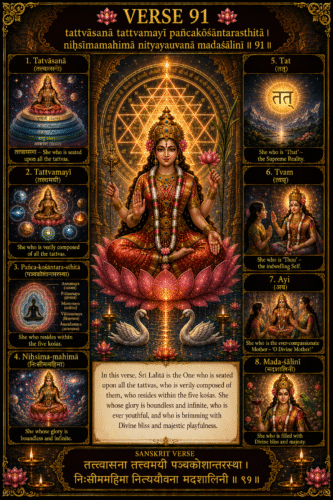
91
Sanskrit:
तत्त्वासना तत्त्वमयी पञ्चकोशान्तरस्थिता ।
निःसीममहिमा नित्ययौवना मदशालिनी ॥ ९१ ॥
English:
tattvāsanā tattvamayī pañcakōśāntarasthitā |
niḥsīmamahimā nityayauvanā madaśālinī ॥ 91 ॥
Tamil:
தத்வாஸனா தத்த்வமயீ பஞ்சகோஶாந்தரஸ்தி²தா ।
நி꞉ஸீமமஹிமா நித்யயௌவனா மத³ஶாலினீ ॥ 91 ॥
Meaning:
This verse reveals Śrī Lalitā as the Reality underlying every layer of our existence, while gradually turning the seeker from external understanding toward intimate inner recognition.
As Tattvāsanā and Tattvamayī, She is both established upon the tattvas and present through them. The body, senses, mind, and intellect are not outside Her; they become the very field through which Her presence is experienced. Yet She also leads us beyond identification with these layers toward the Reality that transcends them.
Pañcakośāntarasthitā then takes the journey inward—from the physical body through life-force, mind, knowledge, and finally bliss. She is present within every sheath, yet shines as the deeper Self at their innermost depth.
Having turned inward, the verse opens into Niḥsīma-mahimā—the Mother’s immeasurable greatness. As our limited understanding expands into spacious awareness, we become increasingly receptive to the Divine Presence.
Finally, Nityayauvanā and Madaśālinī reveal the Mother as eternally fresh, renewed, and filled with divine joy. Her “youth” is not merely physical—it is the ever-renewing vitality of consciousness; Her mada is the fullness and delight of being established in the Divine.
Meditation:
Begin by contemplating Tattvāsanā.
Look at your own body, senses, thoughts, and experiences—not as something separate from the Divine, but as the field through which the Mother’s presence is expressed. Gently ask:
“What is this experience made of? What deeper principle makes it possible?”
Then turn inward with Pañcakośāntarasthitā. Move gently from awareness of the body, to life, to mind, to understanding, and finally toward the quiet sense of inner bliss. At every layer, recognize Her presence.
Now contemplate Niḥsīma-mahimā. Let your awareness become spacious. Release the need to define the Divine completely. As understanding becomes wider and more receptive, allow the Mother’s immeasurable presence to be felt rather than intellectually contained.
Finally, rest in Nityayauvanā and Madaśālinī.
Feel the Mother’s presence as freshness, renewal, fullness, and sacred joy. Let every new beginning, every moment of inner clarity, and every experience of genuine happiness become an opportunity to recognize Her grace.
She is within every layer of our being, beyond every limitation, and ever-fresh in the joy of Divine fullness.
Sanskrit: तत्त्वासना
Tamil: தத்வாஸனா
Meaning: She who is seated upon the tattvas, the fundamental principles of reality. முப்பத்தாறு தத்துவங்களையும் தன் ஆசனமாகக் கொண்டு, அவற்றின் வழியாக உடலிலும் உலகிலும் விளங்கும் பராசக்தி.
Reflection: Tatvāsanā invites us to look at our own body differently. The body that we normally experience as “my body” can itself become Her āsana—Her seat. When we begin to understand the principles that constitute our experience, we begin to see that the body, mind, senses, and consciousness are not separate from the Divine order. She sits upon the tattvas because She is the power underlying them all. And yet, She is also beyond them.
Contemporary Reflection: We often look only at appearances. Tatvāsanā asks us to look deeper. Instead of seeing the body merely as a physical structure, we can see it as a complex expression of life, awareness, sensation, thought, and consciousness. Wisdom begins when we stop asking only “What is this?” and begin asking “What is this made of? What principle makes this experience possible?” Understanding the deeper structure behind appearances can transform the way we relate to ourselves and the world.
Meditation: I sit quietly and become aware of my body. This body is not merely something I possess. I contemplate it as a sacred seat of the Divine Mother. I become aware of my senses. I become aware of my thoughts. I become aware of my understanding, my awareness, and my sense of “I”. Mother Tatvāsanā, may I see the deeper principles behind this experience of life. May I recognize Your presence within this body. May this body become a temple of Your presence. May I understand the tattvas without becoming bound by them. May I remember that You are both seated upon them and beyond them. I offer this body, mind, and awareness as Your āsana.
Sanskrit: तत्
Tamil: தத்
Meaning: She who is “That”, the Supreme Reality indicated through the great Upaniṣadic teachings and Mahāvākyas. அனைத்து பெயர்களாலும் வடிவங்களாலும் சுட்டிக்காட்டப்படும் பரம்பொருளாகவும், அவற்றைக் கடந்த பேருண்மையாகவும் விளங்கும் பராசக்தி.
Reflection: When we say a person's name, we identify a particular person. But “Tat” — “That” can point beyond such limitation. By saying Tat, one can indicate whomever or whatever is intended. In this sense, Tat can encompass the whole of existence in a single expression. Every object has its own form and name, yet the Divine Mother possesses the quality of embracing all forms of existence. She is not confined to one particular deity, one particular form, or one particular name. She is That.
Contemporary Reflection: We often try to define everything. We give things names, categories, descriptions, and boundaries so that the mind can understand them. But truth can be larger than the concepts we use to describe it. Tat reminds us to leave a little space beyond our definitions. Whenever we think, “I understand everything about this,” we can pause and remember: Reality may be greater than my description of it.
Meditation: I sit quietly. I allow names and forms to arise in my awareness. I observe each one without holding onto it. Then I gently contemplate: Tat — That. That which is beyond this name. That which is beyond this form. That which embraces all names and forms. Mother Tat, lead me beyond the limitations of my concepts. May I recognize the One Reality shining through the many forms of existence. May I become quiet enough to experience what cannot be completely described. I do not try to define Her. I simply bow to That.
Sanskrit: त्वम्
Tamil: த்வம்
Meaning: She who is “Thou” / “You”, the Divine Self addressed in the great Mahāvākya “Tat Tvam Asi” — “You are That.” “நீ” என்று சுட்டப்படும் உயிரின் உள்ளார்ந்த ஆத்ம உண்மையாக விளங்கும் பராசக்தி.
Reflection: When we say “You,” we normally point toward another person. But in the Mahāvākya, Tvam takes us on an inward journey. Who is this “you”? Am I merely the body? Am I merely the mind? Am I merely my thoughts, memories, and experiences? The teaching invites us to look deeper. The Divine Mother who is addressed as Tvam is the innermost reality of the one who seeks Her. The seeker and the sought are brought into profound intimacy.
Contemporary Reflection: We often imagine spirituality as something we must travel toward. We look outside ourselves for answers, guidance, strength, and peace. Tvam gently reverses that movement. Before searching everywhere else, pause and ask: Who is the “I” that is searching? The Divine is not necessarily far away. The sacred can be discovered in the very awareness through which we experience life.
Meditation: I sit quietly. I observe my body. I observe my thoughts. I observe my feelings and memories. Then I gently ask: Who is the “I” that is aware of all this? I turn my attention inward. Mother Tvam, reveal Yourself as the innermost reality within me. May I understand that the Divine is not distant from me. May I recognize Your presence in the very awareness through which I know myself. When I worship You, may I become aware of the One who is being worshipped within. Tat — That. Tvam — You. May the distance between the seeker and the sought dissolve in Your grace.
Sanskrit: अयि
Tamil: அயி
Meaning: A loving and intimate form of address meaning “O Mother!”, and traditionally also used affectionately toward a mother or sister. அன்பும் உரிமையும் மிகுந்து “அம்மா!” என்று அழைக்கப்படும் எளிமையான, அணுக்கமான பராசக்தி.
Reflection: After contemplating the Supreme Reality as Tat and the inner Self as Tvam, something beautiful happens. The Infinite becomes intimate. The Supreme Mother can be called simply: Ayi — Amma! There is no distance in this word. There is affection. There is trust. There is belonging. The Divine is no longer approached only as the immeasurable Absolute. She becomes the Mother whom we can lovingly call, speak to, and approach with the freedom of a child.
Contemporary Reflection: Spirituality can sometimes become very philosophical. We ask profound questions about reality, consciousness, and the Self. But there is another dimension of spiritual life: relationship. We need not always speak to the Divine in formal language. Sometimes the deepest prayer may simply be: “Amma.” Ayi reminds us that love can create an intimacy with the Divine that intellectual understanding alone cannot provide.
Meditation: I sit quietly before the Divine Mother. I do not search for complicated words. I simply call: “Amma.” I allow myself to feel the closeness of a child calling its Mother. I speak to Her with love. I speak to Her with trust. I ask Her without fear. Mother Ayi, let me feel that I belong to You. May I approach You not only with reverence, but also with love and intimacy. May I have the freedom to place my heart before You exactly as it is. I call You: Ayi… Amma. And I rest in the closeness of Your presence.
Sanskrit: पञ्च-कोशान्तर-स्थिता
Tamil: பஞ்ச-கோஶாந்தர-ஸ்தி²தா
Meaning: She is present within the five kośas, - physical, vital, mental, intellectual, and bliss sheaths, yet She is deeper than all of them—the Divine Presence discovered as we journey inward. அன்னமயத்திலிருந்து ஆனந்தமயம் வரை உள்ள ஐந்து கோசங்களுக்குள்ளும் உறைந்து, அவற்றின் உள்ளார்ந்த ஆத்ம உண்மையாக விளங்கும் பராசக்தி.
Reflection: We normally experience ourselves through layers. First, there is the body. Then there is the life-force that animates it. There is the mind with its thoughts and memories. There is the faculty of understanding. And there is the deeper experience of bliss. The Divine Mother is present within every one of these layers. She is not somewhere outside waiting to be discovered. She is already within us, quietly sustaining, protecting, and nurturing us. The spiritual journey is the gradual movement through these layers toward the innermost Divine Presence.
Contemporary Reflection: We often identify ourselves with whatever is most visible: “My body.” “My thoughts.” “My emotions.” “My achievements.” “My knowledge.” Pañca-kośāntara-sthitā reminds us that none of these surface identities completely defines who we are. Self-discovery means looking deeper. When we move beyond one layer and then another, we begin to discover a dimension of ourselves that cannot be reduced to any single outer identity.
Meditation: I become aware of my body. I thank the Mother who sustains it. I become aware of my breath and life-force. I become aware of my thoughts, memories, and feelings. I become aware of my understanding and knowledge. I become aware of the deeper experiences of joy and peace. Layer by layer, I turn inward. Mother Pañca-kośāntara-sthitā, You are present within every layer of my existence. You are within me as I am. You sustain me. You protect me. You nurture me. May I move beyond identification with each outer layer and discover the Divine Presence within. May I recognize that the Mother I seek is already dwelling in the deepest centre of my being.
Sanskrit: निःसीम-महिमा
Tamil: நிஃஸீம-மஹிமா
Meaning: She whose glory, greatness, and divine qualities are without limit. எல்லையற்ற பெருமையும் அளவிட முடியாத தெய்வீக மகிமையும் கொண்ட பராசக்தி.
Reflection: We can measure many things. We can measure distance. We can measure time. We can describe forms and qualities. But there is something in the Divine that refuses to be confined by measurement. Niḥsīma-mahimā is the Mother whose greatness has no boundary. The vastness of space gives us a glimpse of this idea. The sky appears limitless to our eyes, yet even the sky is only an image through which we may contemplate something still greater. Her glory extends beyond whatever the mind can grasp.
Contemporary Reflection: We live surrounded by boundaries—time, space, roles, identities, responsibilities, and definitions. Niḥsīma-mahimā reminds us that reality is always larger than the small portion we currently understand. Humility arises when we recognize how little we know. Gratitude arises when we realize that even a glimpse of the Divine is itself a blessing. Instead of trying to possess the whole truth, we can learn to remain open to its vastness.
Meditation: I look at the vastness of the sky. I allow my mind to become spacious. I notice that the space outside me seems boundless. Then I gently turn inward. There is also a space within me. A space of awareness. A space in which thoughts arise and disappear. Mother Niḥsīma-mahimā, reveal Your limitless presence to me. May I recognize that Your greatness cannot be confined by my understanding. May the vastness outside remind me of the vastness within. May my mind become humble before Your immeasurable glory. I bow to the One whose greatness has no boundary.
Sanskrit: नित्य-यौवना
Tamil: நித்ய-யௌவனா
Meaning: She who is eternally youthful. என்றும் இளமையுடனும் அழியாத புத்துணர்ச்சியுடனும் விளங்கும் பராசக்தி.
Reflection: The Goddess is eternally fresh, vibrant, and full of creative vitality. Her eternal youth is not merely about physical age; it points to a divine freshness that is never diminished by time. Just as creation continually renews itself, Her presence remains ever-new.
Contemporary Reflection: Life may change our body, circumstances, and responsibilities, but the capacity for wonder, learning, enthusiasm, and renewal need not grow old. Nitya-yauvanā reminds us to keep an inner freshness—to remain curious, receptive, and willing to begin again.
Meditation: I sit quietly and contemplate Her as eternally fresh and radiant. I let go of the feeling that I am defined by age, past experiences, or limitations. I become aware of a deeper vitality within me that can renew itself. May Her eternal freshness awaken freshness in my body, clarity in my mind, openness in my heart, and aspiration in my spiritual life. I bow to Her who is ever-new.
Sanskrit: मद-शालिनी
Tamil: மத³-ஶாலினீ
Meaning: She who is endowed with divine joy, delight, and bliss. தெய்வீக ஆனந்தமும் மகிழ்ச்சியும் நிறைந்தவளாக விளங்கும் பராசக்தி.
Reflection: The Goddess abides in a deep joy that arises from the fullness of Her own divine nature. Her mada is not worldly pride or intoxication; it is the happiness and loving fulfillment of one who is completely established in divine completeness. She delights in Her relationship with Śiva and in the fullness of Her divine role as consort, mother, and universal Śakti.
Contemporary Reflection: There is a beautiful difference between egoistic pride and the quiet happiness of knowing that one belongs, that one is loved, and that one’s life has meaning. Mada-śālinī reminds us to recognize the sources of wholesome joy in our own lives—loving relationships, belonging, meaningful responsibility, and inner fulfillment—without allowing that joy to become ego.
Meditation: I sit quietly and contemplate Her as the embodiment of divine joy. I allow myself to experience gratitude for the relationships and responsibilities that give meaning to my life. I contemplate Her beside Śiva—not withdrawing from the world, but remaining fully engaged in Her divine work. May my happiness become deeper than circumstances. May my relationships become sources of loving fulfillment. May I perform my responsibilities with joy rather than burden. May the bliss within me express itself through selfless action. I bow to Mada-śālinī, whose joy is full and whose action never ceases.
Audio courtesy of The Sanskrit Channel
Video courtesy of Sri Sankara TV YouTube channel