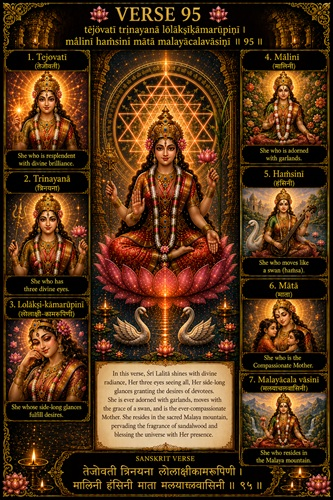
95
Sanskrit:
तेजोवती त्रिनयना लोलाक्षीकामरूपिणी ।
मालिनी हंसिनी माता मलयाचलवासिनी ॥ ९५ ॥
English:
tējōvatī trinayanā lōlākṣīkāmarūpiṇī |
mālinī haṃsinī mātā malayāchalavāsinī ॥ 95 ॥
Tamil:
தேஜோவதீ த்ரினயனா லோலாக்ஷீகாமரூபிணீ ।
மாலினீ ஹம்ஸினீ மாதா மலயாசலவாஸினீ ॥ 95 ॥
Meaning:
This verse presents the Divine Mother as radiance, vision, compassionate responsiveness, sacred sound, discernment, universal motherhood, and sanctifying presence. These are not disconnected attributes: together they describe how the Divine becomes knowable and intimate to the seeker.
Tejovatī establishes the light by which understanding becomes possible. Trinayanā deepens that light into complete vision—the wisdom to see across time, recognise what should be created or preserved, and release what has fulfilled its purpose. Lolākṣī-kāmarūpiṇī then brings divine vision into relationship: the Mother’s compassionate attention meets sincere aspiration in forms appropriate to the seeker, while also inviting desires to become clearer and more worthy.
Mālinī gathers the many sounds, letters, prayers, and acts of remembrance into a sacred garland. Haṃsinī turns this gathered attention inward, teaching the seeker to listen and discriminate between distraction and what is essential. Mātā widens the resulting awareness into universal care: no being lies outside Her maternal embrace. Malayācala-vāsinī brings the sequence to a quiet, grounded culmination. The sacred is encountered in a sanctified place, in the fragrance-like subtlety of mantra, and in a mind made receptive through stillness.
The verse’s movement may be understood as: **Radiance → Wise Vision → Responsive Grace → Sacred Sound → Inner Discernment → Universal Care → Sanctified Presence.** The Mother illumines, guides, gathers, teaches, embraces, and sanctifies.
Meditation:
Sit quietly and first contemplate a steady light. Let Tejovatī remind you that clarity is more than brightness: it is the awareness through which your thoughts and intentions become visible to you. With Trinayanā, widen your vision. Ask what you have learned from the past, what requires attention now, and what your choices may create, preserve, or release.
Bring a sincere aspiration before Lolākṣī-kāmarūpiṇī without insisting that guidance arrive in one expected form. Remain open to wisdom appearing through a person, opportunity, responsibility, or difficult experience. Then remember Mālinī: let each quiet repetition of prayer, each kind word, and each purposeful action become a bead in the garland of remembrance.
With Haṃsinī, listen to the natural breath without forcing it. Notice the difference between the noise that scatters attention and the quiet that helps you recognise what matters. With Mātā, bring to mind people you love, people you find difficult, and beings beyond your immediate circle. Offer them the same care you would wish to receive.
Finally, imagine a sacred mountain in stillness, with the subtle fragrance of sandalwood moving through the air. Contemplate Malayācala-vāsinī as the presence that makes a place holy and allows remembrance to spread gently. Rest for a few breaths in this sense of quiet sanctity. May the Mother’s light clarify your seeing, Her wisdom refine your desires, and Her universal care become visible through your conduct.
Sanskrit: तेजोवती
Tamil: தேஜோவதீ
Meaning: She who is filled with divine radiance, brilliance, and spiritual energy. தெய்வீக ஒளி, பிரகாசம், ஆன்மிக சக்தி ஆகியவற்றால் நிறைந்த பராசக்தி.
Reflection: The Mother is experienced as luminous spiritual power. Her tejas is not merely physical brilliance; it is the inner radiance through which wisdom, vitality, clarity, and spiritual strength become manifest. In contemplation, this light can be experienced as a symbol of pure consciousness—the illumination through which ignorance gives way to understanding and the deeper nature of the Self becomes discernible.
Contemporary Reflection: Tejovatī reminds us that our strongest radiance comes from integrity, clarity, and inner alignment. When what we think, say, and do are in harmony, confidence becomes quiet strength rather than display. Inner light does not need to compete for attention; it naturally reaches others through the quality of our presence.
Meditation: I sit quietly and imagine a steady flame of light within me. I allow that light to become a symbol of awareness, clarity, and the presence of the Divine. I may gently contemplate the light at the centre of the brow, as taught in traditional meditation, without forcing the experience. As I breathe, I remember Tejovatī as the Mother who is herself luminous. May Her light illumine my thoughts, purify my intentions, and guide my actions.
Sanskrit: त्रिनयना
Tamil: த்ரினயனா
Meaning: She who has three eyes. மூன்று கண்களைக் கொண்ட பராசக்தி.
Reflection: The Divine Mother is the One who possesses three eyes. Her three eyes are traditionally understood as the sun, the moon, and fire: the sun representing creation, the moon preservation, and fire dissolution. Her vision therefore encompasses the complete movement of life—what must be brought into being, what must be protected, and what must finally be released or transformed. The Guru’s teaching also presents Her as the One who guides us through the different experiences of life and leads us toward the right path. Her threefold vision can be contemplated as the wisdom to understand what has already happened, remain clear about what is happening now, and act with awareness of where our choices may lead. Her third eye points beyond ordinary perception toward the light of spiritual knowledge. To contemplate Trinayanā is therefore to seek clarity: the discernment to know what should be created, what should be preserved, what should be released, and which path is truly wholesome. She does not merely give us sight; She teaches us how to see rightly.
Contemporary Reflection: We often see only what is immediately before us. Trinayanā encourages us to widen our perspective—to learn from the past, remain attentive to the present, and consider the consequences of our choices. Her threefold vision also gives us a practical question: What should I begin, what should I preserve, and what should I let go? Asking these questions with patience can turn confusion into clearer and wiser action.
Meditation: May I learn from my past without being bound by it, remain awake to the present without being distracted, and look toward the future with responsibility and trust. May Her three sacred lights guide me to create what is good, preserve what is precious, and release what no longer serves its purpose. May Her inner eye of wisdom open within me, so that I may not merely see what is before me, but understand the path I am being called to walk.
Sanskrit: लोलाक्षी-कामरूपिनी
Tamil: லோலாக்ஷீ-காமரூபினீ
Meaning: She who has beautifully moving eyes and assumes forms according to the desires of devotees. அசைவுடன் அழகாக விளங்கும் கண்களையுடையவளும், பக்தர்களின் விருப்பத்திற்கேற்ப வடிவெடுப்பவளுமான பராசக்தி.
Reflection: The Divine Mother is ever attentive to those who approach Her. Lolākṣī conveys the image of beautifully moving or expressive eyes—eyes that seem to remain aware, watching with compassion and responding to the devotee. Her gaze therefore represents Her attentive presence and readiness to guide. Kāmarūpiṇī reveals another dimension of Her compassion: She can assume an appropriate form according to the sincere aspiration and maturity of the person who approaches Her. The Guru’s teaching describes Her as coming in accordance with the devotee’s level and blessing them in the way most appropriate to their need. She may therefore be experienced differently by different devotees, while remaining the same Divine Mother. This teaching also reminds us that divine guidance does not always arrive in a form we expect. The Mother may work through a person, an opportunity, an experience, or even a challenge that changes the direction of our life. Her grace may take the form needed to lead us forward.
Contemporary Reflection: We often expect guidance to appear in a particular form. Lolākṣī-kāmarūpiṇī reminds us to remain receptive. A helpful person, an unexpected opportunity, a difficult experience, or a new responsibility may become the very form through which wisdom reaches us. Her teaching also invites us to examine our desires. Not every desire deserves fulfilment; the deeper prayer is that our desires become worthy, clear, and aligned with a higher purpose.
Meditation: I contemplate the Divine Mother whose compassionate eyes are ever attentive to me. I place my sincere aspiration before Her without insisting that She must answer in the form I expect.May I recognise Her grace when it comes through an unexpected person, circumstance, opportunity, or challenge. May She transform my desires into clearer aspirations and guide me toward what is truly beneficial. O Mother, take whatever form is needed to lead me toward wisdom, fulfilment, and the highest good.
Sanskrit: मालिनी
Tamil: மாலினீ
Meaning: She who wears a garland; She who is adorned with sacred letters and mantric energies. புனித மாலையை அணிந்தவளும், எழுத்துகளின் மற்றும் மந்திர சக்திகளின் தெய்வீக மாலையால் அலங்கரிக்கப்பட்டவளுமான பராசக்தி.
Reflection: Tthe Divine Mother is experienced as the One who wears a sacred garland. At the outer level, a garland is an ornament of beauty and auspiciousness; in the deeper teaching given for this nāma, the garland becomes a symbol of mantra, sacred letters, and the many forms through which divine sound is expressed. The akṣamālā held by the Goddess therefore points naturally toward japa—the repeated remembrance of mantra—while the lotus and other forms of worship remind us that devotion can become both an offering and a disciplined practice. The Guru's teaching especially connects Mālinī with the letters from A to Śa and with the traditional contemplation of the Goddess through the sacred letters. In this understanding, the letters are not merely marks used for communication; they are expressions of Śakti. The garland is therefore a beautiful way of contemplating the relationship between sound, mantra, worship, and the Divine Mother. To hold the mantra with attention is, symbolically, to place one sacred letter after another upon the garland of remembrance. Mālinī also teaches us that spiritual practice is formed through continuity. A single bead does not make a mālā; it is the gathering of many beads into one sacred whole that gives the garland its beauty and purpose. In the same way, repeated remembrance, prayer, worship, and right intention gradually form a life oriented toward the Divine. The Mother is not only the One who wears the garland; She is the sacred presence toward which the garland of our practice is offered.
Contemporary Reflection: Our lives too are formed from many individual moments. A kind word, a prayer, a disciplined choice, a moment of patience, and an act of service may each seem small when viewed separately. When gathered consciously, however, they become a beautiful spiritual garland. Mālinī invites us to give meaning to these small moments rather than waiting for one extraordinary experience to transform us.
Meditation: I gently bring my attention to the sacred sound of the mantra. With each repetition, I imagine placing one luminous bead upon a garland offered to the Divine Mother. I do not rush to complete the garland. I remain with each sound, each breath, and each remembrance. Mālinī, may my scattered thoughts become gathered, my speech become sacred, and my daily actions become offerings at Your feet.
Sanskrit: हंसिनी
Tamil: ஹம்ஸினீ
Meaning: She who is like the divine swan; the embodiment of purity, discrimination, and spiritual wisdom. தெய்வீக அன்னத்தைப் போன்றவளும், தூய்மை, விவேகம் மற்றும் ஆன்மிக ஞானத்தின் வடிவமாக விளங்குபவளுமான பராசக்தி.
Reflection: The Divine Mother is contemplated through the image of the haṃsa—the sacred swan. The swan becomes a beautiful symbol of the seeker's movement toward what is essential. In the familiar spiritual understanding of the haṃsa, discrimination means learning to recognize what is lasting and meaningful amid the many changing impressions of life. Haṃsinī therefore points us toward viveka: the quiet clarity that helps us see what deserves our attention and what can be released. The Guru's teaching opens another intimate dimension of this nāma. Here, the haṃsa is not merely an external symbol but is connected with a mantra that accompanies the breath and with a subtle sound that remains with us throughout life. The teaching invites us to listen—to become attentive to the inner movement of breath and the sound associated with it. Through such attentive listening, the seeker is shown a way of turning inward and becoming receptive to Ummaiyammai's grace. This makes Haṃsinī a teaching about both discrimination and listening. Viveka is not only an intellectual ability to separate one idea from another; it is a deeper sensitivity that allows us to recognize the sacred presence within. When attention becomes quiet, the mantra is heard, the mind becomes inward, and the Mother may reveal Herself as an inner vision of grace. Haṃsinī thus guides the seeker from outer noise toward inner awareness, from distraction toward listening, and from listening toward divine recognition.
Contemporary Reflection: Modern life constantly asks us to listen—to notifications, opinions, advertisements, urgent messages, and competing demands. Haṃsinī reminds us that wisdom also requires knowing what not to listen to. When we create a little inner quiet, we can hear the values, responsibilities, relationships, and spiritual aspirations that truly matter.
Meditation: I sit quietly and bring my attention to the natural movement of the breath. I do not force the breath or chase an experience. I simply listen. With each inhalation and exhalation, I remember the sacred haṃsa mantra and allow my attention to become inward and still. Haṃsinī, teach me to hear what is subtle, to distinguish what is essential, and to recognize Your presence within the quiet space of my own heart.
Sanskrit: माता
Tamil: மாதா
Meaning: She who is the Mother of all beings. அனைத்து உயிர்களுக்கும் தாயாக விளங்குபவள்.
Reflection: The Divine Mother is the universal source of care. She gives birth to life, nourishes and protects it, and ultimately receives all creation back into Herself. No being stands outside Her maternal embrace. Her motherhood is not limited by family, community, species, or circumstance; it is the all-encompassing presence from which life receives sustenance and to which it belongs. The Guru’s teaching brings this universal motherhood into a more specific traditional frame through the Sapta Mātṛkā-s, the Seven Mothers associated with Śiva’s retinue. In the teaching provided, they create a supportive setting through which a worshipper may receive divine grace, and they are associated with mental integration and the seven dhātu-s of the body. They are also described as presiding over the body’s vital centres of power. These details give Mātā a dimension of maternal care that is connected with traditional understandings of embodied life and spiritual practice.
Contemporary Reflection: Mātā invites us to widen the circle of care. We can begin with family and friends, but her universal motherhood asks us not to stop there. The vulnerable, the unfamiliar, other forms of life, and the natural world also deserve consideration. A small act of protection, patience, or generosity can become a practical expression of reverence for the universal Mother.
Meditation: I rest quietly and imagine all beings held within the boundless care of the Divine Mother. I bring to mind someone I love, someone I find difficult, and a living being beyond my immediate circle. May I learn to see each with greater patience and compassion. Mātā, help me receive Your care with gratitude and extend that care through my own words and actions.
Sanskrit: मलयाचल वासिनी
Tamil: மலயாசல வாஸினீ
Meaning: She who dwells in the Malaya mountains. மலய மலைகளில் வாழ்பவளான பராசக்தி.
Reflection: The Divine Mother dwells upon the Malaya mountain, at its summit or sacred heights. The mountain is more than a place in the landscape: it is a setting where earth rises toward the sky, and where stillness can turn the mind toward reverence. In this nāma, the mountain becomes sacred because the Mother is present there. The Guru’s teaching brings this mountain imagery into the practice of temple worship. It refers to the traditional processes of collecting stone for an image—śilā-saṅgraha—and collecting earth—mṛt-saṅgraha. The stone from which a sacred image is fashioned is not treated as an ordinary material alone; the place from which it is taken is approached with ritual reverence. The teaching describes the Malaya mountain as a sanctified place associated with the preparation of divine images and with the presence of the Goddess. The secondary explanation adds another layer: the Malaya region is associated with sandalwood and its natural fragrance. This fragrance becomes an image for the subtle influence of mantra—unseen, yet perceptible through its effects. Malayācala-vāsinī can therefore be contemplated both as the Mother who dwells in a sacred mountain and as the presence whose mantra-śakti spreads gently, like fragrance, beyond what the eye can see. Her dwelling sanctifies the place; Her presence can also sanctify the mind.
Contemporary Reflection: Malayācala-vāsinī reminds us to seek moments of stillness and elevation amid constant activity. We may not always be able to visit a mountain, but we can create a quiet place for reflection, prayer, and renewed perspective. Like fragrance spreading through the air, a calm and thoughtful presence can influence the spaces and people around us without force or display.
Meditation: I imagine a sacred mountain rising in quiet majesty. At its summit, I contemplate the Divine Mother, whose presence makes the mountain holy. I breathe gently and imagine the subtle fragrance of sandalwood spreading through the still air. May my thoughts become quiet, my actions become worthy of reverence, and the remembrance of the Mother spread through my life as naturally as fragrance.
Audio courtesy of The Sanskrit Channel
Video courtesy of Sri Sankara TV YouTube channel