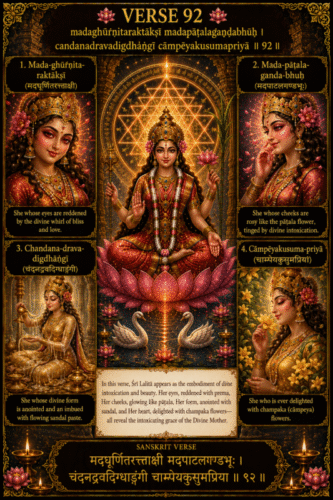
92
Sanskrit:
मदघूर्णितरक्ताक्षी मदपाटलगण्डभूः ।
चन्दनद्रवदिग्धाङ्गी चाम्पेयकुसुमप्रिया ॥ ९२ ॥
English:
madaghūrṇitaraktākṣī madapāṭalagaṇḍabhūḥ |
chandanadravadigdhāṅgī chāmpēyakusumapriyā ॥ 92 ॥
Tamil:
மத³கூ⁴ர்ணிதரக்தாக்ஷீ மத³பாடலக³ண்ட³பூ⁴꞉ ।
சந்த³நத்³ரவதி³க்³தா⁴ங்கீ³ சாம்பேயகுஸுமப்ரியா ॥ 92 ॥
Meaning:
This verse reveals Śrī Lalitā as divine joy made visible, experienced as radiant beauty, transformed into cooling grace, and finally expressed through simple and sincere devotion.
Madaghūrṇitaraktākṣī and Madapāṭalagaṇḍabhūḥ portray the outward radiance of profound spiritual joy. Her eyes and cheeks reflect an inner fullness that is vibrant, awake, and overflowing into Her form. This is not merely physical beauty; it symbolizes the vitality and auspiciousness arising from divine fulfillment.
With Chandanadravadigdhāṅgī, that intensity becomes peaceful and cooling. The fragrance and coolness of sandalwood offer a beautiful image of grace that settles agitation and restores serenity.
Finally, Chāmpēyakusumapriyā brings this divine fullness into the simplest expression of love—a flower offered with sincerity. The verse therefore moves beautifully from inner bliss to outer radiance, from radiance to serenity, and from serenity to loving offering.
Meditation:
Begin by visualizing the Mother’s radiant eyes as Madaghūrṇitaraktākṣī. Let Her divine joy remind you that spiritual awareness can be vibrant and alive. Allow that inner joy to become courage, compassion, alertness, and loving presence in your own life.
Contemplate Madapāṭalagaṇḍabhūḥ and imagine that same fullness gently illuminating Her face. Ask yourself whether the happiness within you can become kindness and warmth toward others, without pride or display.
Then rest in Chandanadravadigdhāṅgī. Imagine the cool fragrance of sandalwood surrounding the Mother and allow your own agitation to settle. May your thoughts become calmer, your words more soothing, and your presence a source of peace.
Finally, offer Her a simple Champaka flower as Chāmpēyakusumapriyā. Let it represent sincerity rather than grandeur. As the flower naturally gives its fragrance, allow affection, gratitude, patience, and kindness to become offerings from your own heart.
Sanskrit: मद-घूर्णित-रक्ताक्षी
Tamil: மத³-கூ⁴ர்ணித-ரக்தாக்ஷீ
Meaning: She whose eyes appear reddish and gently rolling from divine ecstasy. தெய்வீக ஆனந்தத்தில் சிவந்து, மெல்லச் சுழலும் கண்களையுடைய பராசக்தி.
Reflection: Her eyes express the overflowing intensity of divine consciousness. Their reddish hue and gentle movement are presented as outward signs of the bliss that fills Her being. The eyes become a beautiful symbol of a consciousness that is not passive or distant, but vibrant, awake, and filled with Śakti.
Contemporary Reflection: Spiritual joy need not be dry, emotionless, or detached from life. It can be vivid, alive, and transformative. She reminds us that when inner awareness deepens, it can change the way we see the world—with greater vitality, compassion, alertness, and presence.
Meditation: I contemplate the Goddess with radiant, gently moving eyes, filled with divine bliss. I allow my attention to become quiet, steady, and deeply present. I imagine Her compassionate gaze resting upon me, removing fear and awakening courage. May I learn to see the world with greater clarity and compassion. May inner joy become energy for purposeful and loving action. I bow to Her whose eyes reveal the fullness of divine consciousness.
Sanskrit: मद-पाटल-गण्ड-भूः
Tamil: மத³-பாடல-க³ண்ட³-பூ⁴꞉
Meaning: She whose cheeks glow with the rosy hue of divine bliss. தெய்வீக ஆனந்தத்தால் சிவந்த ஒளியுடன் விளங்கும் கன்னங்களையுடைய பராசக்தி.
Reflection: The Goddess's cheeks glow with the rosy hue of divine bliss. This poetic image presents Her beauty as the visible expression of an inner fullness that has overflowed into Her very form. The radiance of Her face is therefore not merely physical beauty. It symbolizes the vitality, warmth, and auspiciousness that arise from perfect spiritual fulfillment.
Contemporary Reflection: Inner happiness often expresses itself outwardly—not through appearance alone, but through warmth, kindness, generosity, and a natural radiance in the way we meet others. She reminds us that genuine fulfillment can quietly transform our presence. When the heart is peaceful and joyful, even ordinary interactions can carry warmth.
Meditation: I contemplate the Goddess with softly glowing, rosy cheeks, radiant with divine bliss. I allow myself to rest in a quiet sense of inner fullness. I imagine that this inner joy gently reaches my face, my words, and my actions. May my happiness become kindness. May my inner peace become warmth toward others. May the joy within me express itself naturally, without pride or display. I bow to Mada-pāṭala-ganda-bhūḥ, whose radiant beauty reveals the sweetness of divine fulfillment.
Sanskrit: चन्दन-द्रव-दिग्धाङ्गी
Tamil: சந்த³ன-த்³ரவ-தி³க்³தா⁴ங்கீ³
Meaning: She whose body is anointed with fragrant sandal paste. மணமிக்க சந்தனக் குழம்பால் திருமேனியை அலங்கரித்துக் கொண்டு, குளிர்ச்சியும் அமைதியும் மங்களமும் அருளும் பராசக்தி.
Reflection: The Goddess is adorned with fragrant sandal paste. Sandalwood evokes coolness, purity, serenity, and auspiciousness. Its gentle fragrance and cooling quality provide a beautiful image of divine grace that calms and refreshes. After the intense imagery of the preceding nāma-s, this nāma brings a sense of soothing stillness: divine bliss is now experienced as cooling grace.
Contemporary Reflection: In a world filled with pressure and stimulation, a calming presence can itself become a form of compassion. She reminds us to cultivate qualities that soothe rather than agitate—to bring patience, gentleness, clarity, and warmth into our relationships. Like the fragrance of sandalwood, quiet goodness does not need to announce itself; its presence can be experienced by everyone around it.
Meditation: I contemplate the Goddess whose divine form is gently anointed with fragrant sandal paste. I imagine a cool, peaceful fragrance surrounding Her and filling the space around me. With each breath, I allow agitation to settle and invite calmness into my mind. May my thoughts become cooler and clearer. May my words soothe rather than disturb. May my presence bring peace and freshness to those around me. I bow to Chandana-drava-digdhāṅgī, whose cooling grace refreshes the heart.
Sanskrit: चाम्पेय-कुसुम-प्रिया
Tamil: சாம்பேய-குஸும-ப்ரியா
Meaning: She who delights in Champaka flowers. செண்பக மலரை மிகவும் விரும்பும் மலரன்பு நிறைந்த பராசக்தி.
Reflection: The Goddess delights in the beauty and fragrance of the Champaka flower. The flower becomes more than an ornament: it is a simple and beautiful offering through which the devotee expresses love. The tradition reminds us that devotion does not require grandeur. A flower offered with sincerity can become a complete expression of the heart.
Contemporary Reflection: Sincerity matters more than grandeur. A small offering given with love can carry greater meaning than an elaborate gesture offered without feeling. The flower also gives us a gentle reminder: love naturally seeks expression. When the heart is full of gratitude, even a simple act can become sacred.
Meditation: I visualize the Goddess surrounded by the fragrance of Champaka flowers. I offer Her a single flower with a quiet and sincere heart. I let the simplicity of the offering remind me that devotion does not depend upon outward grandeur. May my relationships be nourished by sincerity rather than expectation. May my words carry the fragrance of kindness. May every small act of love become an offering to Her. I bow to Chāmpeya-kusuma-priyā, who receives the fragrance of devotion with love.
Audio courtesy of The Sanskrit Channel
Video courtesy of Sri Sankara TV YouTube channel