61
Sanskrit:
पञ्चप्रेतासनासीना पञ्चब्रह्मस्वरूपिणी ।
चिन्मयी परमानन्दा विज्ञानघनरूपिणी ॥ ६१ ॥
English:
pañchaprētāsanāsīnā pañcabrahmasvarūpiṇī |
chinmayī paramānandā vijñānaghanarūpiṇī ॥ 61 ॥
Tamil:
பஞ்சப்ரேதாஸநாஸீநா பஞ்சப்³ரஹ்மஸ்வரூபிணீ ।
சிந்மயீ பரமாநந்தா³ விஜ்ஞாநக⁴நரூபிணீ ॥ 61 ॥
Meaning:
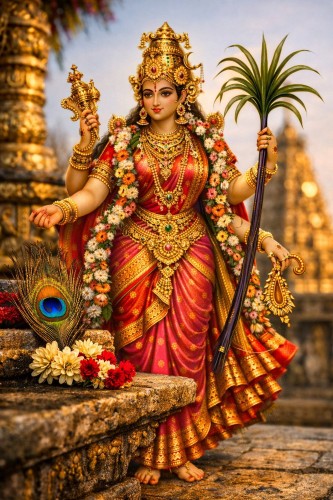
In this 61st verse, Śrī Lalitā appears as:
The Supreme Conscious Power seated upon the pañca pretas —Brahmā, Viṣṇu, Rudra, Īśvara, and Sadāśiva — revealing that without Śakti, even these great cosmic forces remain inert (preta). With Her presence, they become living Brahma-tattva, performing creation, preservation, dissolution, concealment, and grace.
As Pañcha-brahma-svarūpiṇī, She is not separate from these functions — She is their unified essence, also reflected as the five elements (pañcha bhūtas) that constitute both the universe and the human body. She is the power that transforms lifeless existence into living consciousness.
As Chinmayī, She is pure awareness — the inner intelligence that protects, guides, and enables right understanding. She is the arivu within, the source of clarity, memory, and discrimination, removing confusion and stabilizing the mind.
As Paramānandā, She is the inner bliss that cannot be seen externally but is experienced within. She sustains physical well-being, mental balance, and life-force, and creates the conditions for the attainment of 16 forms of wealth (selvam) — including health, clarity, strength, and fulfillment.
As Vijñānaghana-rūpiṇī, She is condensed, living wisdom — not theoretical knowledge, but realized truth. She is the intelligence pervading every atom of the body, guiding life with clarity, removing fear of the future, and revealing the right path forward.
Through these forms, Lalitā is both:
- the Cosmic Sovereign governing all divine functions
- and the Inner Reality experienced as consciousness, bliss, and wisdom
She is the one who:
- removes pitṛ-doṣa and karmic burdens
- dissolves fear and confusion
- grants clarity, health, and inner strength
- leads the seeker toward Ātma-jñāna and liberation
Meditation:
This verse reveals the Mother as both the power behind the universe and the truth within the self.
Meditating on Lalitā as Pañca-pretāsanāsīnā reveals:
- Without Śakti, everything becomes inactive
- With Her presence, life becomes dynamic and meaningful
- Even the highest powers depend on inner energy
This reminds us:
Without inner awareness, life becomes mechanical —with awareness, it becomes alive and purposeful.
Meditating on Her as Pañcha-brahma-svarūpiṇī reveals:
- All phases of life — creation, growth, change, concealment, and grace — are divine processes
- The same power operates in the universe and within our body
Meditating on Her as Chinmayī reveals:
- Awareness is the true protector
- Clarity removes confusion
- Intelligence arises from stillness
Meditating on Her as Paramānandā reveals:
- Bliss is not outside — it is within
- Health, strength, and fulfillment arise from inner balance
- Contentment creates abundance in life
Meditating on Her as Vijñānaghana-rūpiṇī reveals:
- True knowledge removes fear
- Life becomes guided with clarity
- Wisdom transforms experience into realization
Sanskrit: पञ्च-प्रेता-सनासीना
Tamil: பஞ்ச-ப்ரேதா-ஸனாஸீனா
Meaning: She who is seated upon the throne of the five “pretas” — the five cosmic deities who become powerless without Her Śakti
Reflection: As Pañcha-pretāsanāsīnā, She is the life-giving consciousness seated above all cosmic powers. Even the greatest divine functions depend upon Her energy. She is the supreme animating consciousness behind all cosmic functions. She is the force that makes existence alive.
Contemporary Reflection: This name teaches a profound truth: Without inner awareness, life becomes mechanical. But when consciousness awakens: • actions gain meaning • life gains purpose • experience becomes sacred. She is the awareness that turns existence into living wisdom.
Meditation: “I bow to Pañca-pretāsanāsīnā, the Mother who animates all divine powers, who removes ancestral burdens and debts, and awakens the living consciousness within me.”
Sanskrit: पञ्च-ब्रह्म-स्वरूपिणी
Tamil: பஞ்ச-ப்ரஹ்ம-ஸ்வரூபிணீ
Meaning: She who is the very form of the five Brahmas — the fivefold divine functions that govern the universe.
Reflection: As Pañcha-brahma-svarūpiṇī, She is the unified intelligence behind all cosmic functions. As Pañcha-brahma-svarūpiṇī, She is the unified consciousness that expresses itself through all these cosmic functions - Creation, preservation, dissolution, concealment, and grace all arise from Her.
Contemporary Reflection: This name reminds us that life unfolds in cycles: • beginnings • growth • endings • hidden transformations • and blessings. All these phases are expressions of divine order. When we accept this rhythm, life becomes balanced.
Meditation: “I bow to Pañca-brahma-svarūpiṇī, the Mother who manifests as the five cosmic powers, who harmonizes the elements of life and blesses my family with unity and well-being."
Sanskrit: चिन्मयी
Tamil: சின்மயீ
Meaning: She who is pure consciousness itself — the very essence of awareness (Chit).
Reflection: As Chinmayī, She is the light of awareness within all beings. She is not merely aware — She is the awareness by which everything is known. She is the silent witness behind every thought, feeling, and perception.
Contemporary Reflection: Chinmayī teaches: • You are not your thoughts • You are not your confusion • You are the awareness observing them When we return to awareness: • clarity arises • peace settles • decisions become natural.
Meditation: “I bow to Chinmayī, the pure consciousness within me, who grants clarity, protection, and the light of true understanding.”
Sanskrit: परमानन्दा
Tamil: பரமானந்தா
Meaning: She who is Supreme Bliss — the highest joy that exists beyond pleasure and pain.
Reflection: As Paramānandā, She is the bliss of the Self —unaffected by circumstances. Her bliss is not dependent on the world; it is the natural state of divine completeness. Her joy is silent, steady, and complete.
Contemporary Reflection: Paramānandā teaches: • Happiness is not outside • Peace is not conditional • Joy is not achievement-based True bliss arises when: • the mind becomes calm • the heart becomes content • awareness turns inward.
Meditation: “I honor Paramānandā, the supreme bliss within, who grants health, wisdom, strength, and fills my life with divine fullness.”
Sanskrit: विज्ञानघन-रूपिणी
Tamil: விஜ்ஞானகன-ரூபிணீ
Meaning: She whose form is a solid mass of spiritual wisdom (Vijñāna) —not fragmented knowledge, but complete, realized awareness.
Reflection: As Vijñānaghana-rūpiṇī, She is embodied wisdom —the fullness of awakened understanding. She is knowledge not as information, but as direct experience and living truth.
Contemporary Reflection: This name teaches: • Information is not wisdom • Experience is the real teacher • Clarity removes fear • Awareness brings direction When understanding deepens, life becomes simpler and clearer.
Meditation: “I bow to Vijñānaghana-rūpiṇī, the Mother who is the fullness of wisdom, who removes my fears, and shows me the clear path of truth.”
Audio courtesy of The Sanskrit Channel
Video courtesy of Sri Sankara TV YouTube channel