53
Sanskrit:
सर्वयन्त्रात्मिका सर्वतन्त्ररूपा मनोन्मनी ।
माहेश्वरी महादेवी महालक्ष्मीर्मृडप्रिया ॥ ५३ ॥
English:
sarvayantrātmikā sarvatantrarūpā manōnmanī |
māhēśvarī mahādēvī mahālakṣmīrmr̥ḍapriyā ॥ 53 ॥
Tamil:
ஸர்வயந்த்ராத்மிகா ஸர்வதந்த்ரரூபா மநோந்மநீ ।
மாஹேஶ்வரீ மஹாதே³வீ மஹாலக்ஷ்மீர்ம்ருட³ப்ரியா ॥ 53 ॥
Meaning:
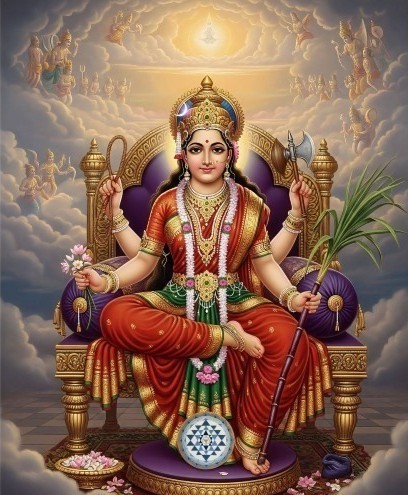
In this 53rd verse, Śrī Lalitā appears as the living power behind all yantras and all tantric paths—the conscious force that makes every sacred method effective.
As Sarva-yantrātmikā, She is the indwelling soul of all yantras.
Temple āgamas, sacred geometries, mātr̥kā letters, and ritual structures derive their power from Her presence. Without Her, yantra is form; with Her, it becomes living śakti. Through Her activation, divine energies move, grace manifests, and even devatā darśanam becomes possible.
As Sarva-tantra-rūpā, She is the essence of all tantra-śāstras—the sacred methods that explain how to worship, approach, and experience the Divine. Tantra is the unseen divine process through which God-experience unfolds, often working silently without our awareness. Through Her tantric grace, the devotee receives dharma, artha, kāma, and mokṣa, along with unexpected spiritual and worldly upliftment.
She then reveals Herself as Manonmanī—the One who carries the seeker beyond mind. Here thought dissolves, and pure awareness shines. United inseparably with Śiva, She is dharma-śakti and sarva-śakti-svarūpa, granting universal grace regardless of place or form, and drawing all goodness toward the devotee.
As Māheśvarī and Mahādevī, She stands as the Supreme Mother—the great Śakti of Śiva. As Māheśvarī, She accepts devotees with maternal compassion, especially as Kula Devatā, granting protection and physical well-being when prayed to with openness of heart. As Mahādevī, She shines as inner light—realized through meditation as an inward journey where prayer placed before dhyāna ripens into lived reality.
As Mahālakṣmī, She becomes the source of experiential abundance. The subtle supreme reality that cannot be grasped outwardly becomes accessible through Her grace. She receives Śiva’s blessings and transmits them to devotees in tangible form—making prosperity not abstract, but lived. Through Her, endeavors move forward swiftly and fruitfully.
Finally, as Mṛḍapriyā, She shines as the beloved of compassionate Śiva—the gentle preserving power that protects the world. Her grace relieves deep suffering, including chronic illness and relentless debt, leading the devotee toward a life free from affliction and burden.
Meditation:
This verse reveals a profound spiritual progression:
All spiritual tools—yantras, tantras, mantras, rituals—are not the final destination.
They are sacred pathways leading inward to the Mother.
Meditate on Lalitā as Sarva-yantrātmikā when seeking protection, structure, and divine alignment.
Feel life arranging itself like a sacred geometry centered in grace.
Meditate on Her as Sarva-tantra-rūpā when seeking method, discipline, and transformation.
Trust that even unseen processes are guiding you toward divine experience.
Meditate on Her as Manonmanī when the mind is restless.
She is the silence beyond thought, drawing awareness into stillness.
Meditate on Her as Māheśvarī when seeking protection, lineage grace, and health.
Approach Her with openness, and receive maternal acceptance.
Meditate on Her as Mahādevī when turning inward.
See Her as light within the mind, guiding meditation into realization.
Meditate on Her as Mahālakṣmī when seeking fulfillment.
Know that prosperity includes stability, dignity, grace, and experiential abundance.
Meditate on Her as Mṛḍapriyā when seeking relief from suffering.
Her compassionate union with Śiva dissolves deep karmic burdens.
Sanskrit: सर्वयन्त्रात्मिका
Tamil: ஸர்வயந்திராத்மிகா
Meaning: She who is the soul of all yantras—the divine intelligence that animates sacred geometric forms. As Sarva-yantrātmikā, She is not merely associated with yantras; She is their living essence, the conscious power that makes them effective.
Reflection: As Sarva-yantrātmikā, the Divine Mother is intimately connected with temple āgamas and sacred ritual science (kōyil āgama thodarbu). A yantra is not just a diagram—it is a means of activation (iyakkam), a subtle form of worship (arūpa vazhipāḍu). Yantras are formed through precise principles—such as the 51 Mātr̥kā letters, geometric structures, and aṣṭāṅga (eightfold) alignment. Yet geometry alone is not enough. It is the Ātmikā principle—the Mother’s indwelling consciousness—that moves all divine energies,reveals grace, and makes worship alive. As Sarva-yantrātmikā, She has the power to activate all deities (samastha devathaiyai iyakkakoodiyaval). Through Her presence, divine vision (devatā darśanam) becomes possible—not as imagination, but as spiritual experience.
Contemporary Reflection: She inspires us to seek structure and alignment in life. When the inner design is clear, outer life naturally becomes harmonious. She reminds us that: • order is sacred • alignment invites grace • structure supports spiritual flow • consciousness gives power to form When life is arranged with awareness—like a yantra aligned to its center—confusion reduces, energy flows correctly, and purpose becomes visible.
Meditation: “I bow to Sarva-yantrātmikā, the Divine Mother who is the soul of all yantras. Activate divine order within me. Align my life to sacred structure, awaken spiritual energy through awareness, and grant me vision of the Divine, through Your living intelligence and grace.”
Sanskrit: सर्वतन्त्र-रूपा
Tamil: ஸர்வதந்திர-ரூபா
Meaning: She who is the very form and essence of all Tantras. As Sarva-tantra-rūpā, She exists as the inner truth behind every spiritual system, method, and sacred discipline meant for the worship and realization of the Divine. Here, rūpa means form, and tantra refers to the sacred texts and methods that explain how to worship, approach, and experience God.
Reflection: As Sarva-tantra-rūpā, the Divine Mother embodies all Tantra-śāstras—anaithu tantra śāstra vadivamāga iruppaval.Tantra is not merely ritual or technique. It is that subtle divine process by which the soul is guided toward direct experience of God, often working silently and invisibly, without our conscious awareness. Through Her Tantra-form, the Mother grants the four puruṣārthas: • Dharma (aram) – righteous living • Artha (porul) – material well-being • Kāma (inbam) – rightful joy and fulfillment • Mokṣa (veedu) – liberation She makes divine experience (irai anubhavam) possible— sometimes suddenly, sometimes unexpectedly—as Her grace works from outside and within, reshaping life and awareness. By Her Tantra power, devatā darśanam may arise,and unexpected spiritual and worldly benefits (ethirpārātha ullāgiyal lābam) manifest naturally.
Contemporary Reflection: She teaches us that practice is not mechanical. Ritual alone does not transform—sincerity, discipline, purity, and surrender awaken the true power of any path. She reminds us that: • all spiritual paths ultimately lead to the Mother • methods differ, but the source is One • transformation happens through grace as much as effort • divine intelligence works even when we are unaware When life itself begins to guide, correct, and uplift us invisibly, that too is Tantra in action.
Meditation: “I honor Sarva-tantra-rūpā, the Divine Mother who is the essence of all sacred paths. Awaken the true power of spiritual practice within me. Grant me dharma, well-being, joy, and liberation, lead me to direct experience of the Divine, and let Your unseen grace work silently to transform my life and consciousness.”
Sanskrit: मनोन्मनी
Tamil: மனோன்மனி
Meaning: She who transcends the mind—the state where the mind dissolves into supreme awareness. As Manonmanī, She exists beyond thought, beyond fluctuation, as pure consciousness itself.
Reflection: As Manonmanī, She is the silence beyond the mind—the point where mental movement ceases and awareness remains. Here, individuality does not struggle to understand truth; it merges into it. One who is inseparably united with Śiva. In this union, She is Dharma-śakti itself—the power that upholds cosmic order and inner balance. As Sarva-śakti-svarūpa, Manonmanī contains all powers within Herself, yet remains utterly still. Power and silence are not separate in Her; they are one.
Contemporary Reflection: She invites us into meditation beyond noise, beyond worry—into deep stillness where healing happens naturally, without effort. She reminds us that: • peace lies beyond constant thinking • silence is not emptiness, but fullness • when the mind rests, power awakens • grace flows where resistance ends By invoking Manonmanī, the grace of Ambal in every place reaches the devotee. Her blessing is not limited by location, form, or temple—She responds wherever the heart turns inward. Through this name, all forms of goodness begin to approach naturally, as the mind settles and life aligns with higher order.
Meditation: “I bow to Manonmanī, the Divine Mother beyond the mind. Draw me into Your stillness, where thought dissolves and truth shines. United with Śiva, power and silence as One, bless me with all forms of goodness, and let Your grace reach me wherever I may be.”
Sanskrit: माहेश्वरी
Tamil: மாஹேஶ்வரி
Meaning: She who is the supreme power of Maheśvara (Śiva)—the cosmic Mother united with divine consciousness. As Māheśvarī, She is Śakti inseparable from Śiva: awareness and energy existing as one, never apart.
Reflection: As Māheśvarī, She is the One who accepts, receives, and holds the devotee with maternal grace. This name denotes the very qualities of Ambal: strength without harshness, authority without pride, compassion without weakness. She is worshipped intimately as Kula Devatā—the family Mother who protects lineage, continuity, and inner stability. Her presence is close, personal, and responsive to sincere prayer. When one prays to Māheśvarī with a clear, open heart (manadhil vettaveḻiyāga), without fear or concealment, She bestows physical well-being and health, restoring balance to body and mind through Her harmonious power.
Contemporary Reflection: She inspires balance: strength with gentleness, action with wisdom, power with compassion. She reminds us that: • true power is calm and centered • harmony heals faster than force • devotion rooted in honesty invites grace • health flows where mind and heart are aligned Through Māheśvarī, life regains rhythm— decisions become clear, energy becomes steady, and the body responds to inner peace.
Meditation: “I honor Māheśvarī, the Divine Mother united with Śiva. Accept me into Your grace, and hold me with Your compassionate power. As my Kula Devatā, protect my body and mind, restore health and harmony, and let strength and wisdom rise together within me.”
Sanskrit: महादेवी
Tamil: மஹாதேவி
Meaning: She who is the Great Goddess—the supreme Divine Mother worshipped above all. As Mahādevī, She is the one Reality that originates, sustains, and dissolves the universe, appearing as all forms of the Goddess. Here, Devī means the radiant one (oli poruṇḍiyaval), She who shines as divine light.
Reflection: As Mahādevī, She is worshipped by jñānis—those who know truth not by belief alone, but by direct insight. She is the Goddess experienced as inner light, adored by turning the mind inward and recognizing the Divine as luminous awareness. True worship of Mahādevī is dhyāna—an inward journey. When the mind turns within, prayer becomes awareness, and awareness becomes realization. What is sincerely thought and offered before meditation, what is held with clarity and devotion, is absorbed by Her and returns as lived understanding and fulfillment.
Contemporary Reflection: She reminds us that the divine feminine is not separate from life—it is the sacred power within life itself. She teaches us that: • light already exists within the mind • meditation is a journey inward, not escape • intention aligned with clarity bears fruit • joy, wisdom, and vitality arise from inner connection By remembering Mahādevī, health (ārogyam) is strengthened, life-force and longevity (āyus) increase, joy (magizhchi) flows naturally, and noble, elevated thinking (ara sindhanai) awakens.
Meditation: “I bow to Mahādevī, the Great Divine Mother, radiant as inner light. Guide my mind inward through meditation, and awaken clarity, wisdom, and truth within me. Bless me with health, long life, and joy, purify my thoughts, and let Your light shine steadily as love, wisdom, and power in my life.”
Sanskrit: महालक्ष्मी
Tamil: மஹாலக்ஷ்மி
Meaning: She who is the Supreme Lakṣmī—the source of prosperity, fortune, abundance, and auspiciousness. As Mahālakṣmī, She is not merely the giver of wealth, but the very principle of flourishing—materially, emotionally, and spiritually.
Reflection: As Mahālakṣmī, She is the subtle Supreme Reality (paramporuḷ) that cannot be fully grasped through sight, sound, or ordinary perception (kaṇḍu, kēṭṭu, uṭṟu uṇara muḍiyātha paramporuḷ). Yet, out of compassion, She becomes accessible and gentle, receiving the grace of Śiva and transmitting it to devotees in a form they can experience and benefit from. She does not only grant blessings—She makes us experience and enjoy them (anubavikka seikriaval). Prosperity through Her is not abstract; it is lived, felt, and sustaining. By Her grace, endeavors begin to move forward swiftly and smoothly (entha kāriyamum uḍanadiyāga naḍakkum) as obstacles dissolve and supportive conditions arise.
Contemporary Reflection: She teaches that abundance is not limited to money—it includes peace, opportunity, dignity, nourishment, and fulfillment. She reminds us that: • prosperity grows where gratitude lives • discipline sustains abundance • generosity multiplies blessings • grace makes effort fruitful When Mahālakṣmī’s presence is invoked, life begins to feel supported—needs are met, efforts gain momentum, and well-being expands naturally.
Meditation: “I honor Mahālakṣmī, the Supreme Mother of abundance. You who make the unseen grace tangible, bless my life with prosperity and peace. Let my efforts bear fruit swiftly, grant me both material well-being and inner richness, and help me live in gratitude, dignity, and fulfillment.”
Sanskrit: मृडप्रिया
Tamil: ம்ருடப்ரியா
Meaning: She who is dear to Mṛḍa (Śiva)—the compassionate Lord. As Mṛḍapriyā, She is the beloved of Śiva, reflecting the sacred intimacy between consciousness and divine power.
Reflection: As Mṛḍapriyā, She is deeply loved by Rudra (anbu miguthal to Rudran). The name Mṛḍa denotes Śiva as the gentle, compassionate, and protective One— the Lord who safeguards the world from dissolution. “Mṛḍa” also carries the quality of tenderness—the soft, soothing, grace-filled nature that heals and protects. As His beloved, the Mother embodies this same gentle compassion—comforting, restoring, and preserving life. Through Her grace, even intense worldly burdens begin to ease. She is invoked to relieve: • chronic or incurable illness (theera vyādhi) • relentless debt and financial strain (ōyā kaḍan) By remembering Mṛḍapriyā, one is blessed with relief from affliction—moving toward a life free from debt and disease (kaḍan illātha, piṇi illātha vāzhkkai).
Contemporary Reflection: She inspires relationships rooted in mutual respect, devotion, and spiritual harmony. She reminds us that: • love grounded in compassion heals • partnership rooted in dharma sustains life • gentleness is strength, not weakness • harmony dissolves suffering Her presence softens life’s harshness—bringing emotional warmth, relational healing, and supportive grace.
Meditation: “I bow to Mṛḍapriyā, beloved of compassionate Śiva. Through Your gentle grace, remove illness, debt, and suffering from my life. Bless me with harmony, health, and freedom, and let Your loving unity with Śiva protect and preserve my path always.”
Audio courtesy of The Sanskrit Channel
Video courtesy of Sri Sankara TV YouTube channel