56
Sanskrit:
महातन्त्रा महामन्त्रा महायन्त्रा महासना ।
महायागक्रमाराध्या महाभैरवपूजिता ॥ ५६ ॥
English:
mahātantrā mahāmantrā mahāyantrā mahāsanā |
mahāyāgakramārādhyā mahābhairavapūjitā ॥ 56 ॥
Tamil:
மஹாதந்த்ரா மஹாமந்த்ரா மஹாயந்த்ரா மஹாஸநா ।
மஹாயாக³க்ரமாராத்⁴யா மஹாபை⁴ரவபூஜிதா ॥ 56 ॥
Meaning:
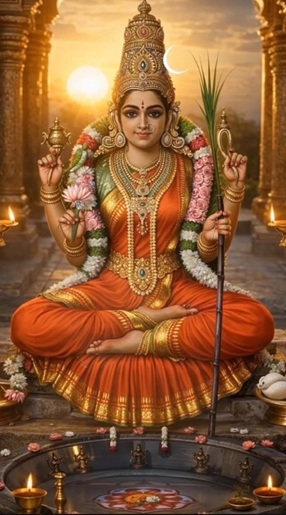
In this 56th verse, Śrī Lalitā appears as:
The Supreme Power behind all sacred spiritual systems—the very essence of Tantra, Mantra, and Yantra. She is the greatest spiritual “seat” (mahāsanā), meaning She is the ultimate foundation on which all worship, meditation, and realization rest.
She is worshipped through the highest and most complete ritual order (mahāyāgakrama), and even Mahābhairava Himself worships Her—revealing that She is the Supreme Goddess, honored by Śiva in His most powerful cosmic aspect.
Meditation:
This verse teaches that the Divine Mother is not merely reached through a single method—She is the living essence of every method.
- If you worship through mantra, She is the mantra.
- If you worship through yantra, She is the yantra.
- If you worship through tantra, She is the inner truth of tantra.
Meditating on Lalitā as mahāsanā reminds us that She is the stable ground beneath all spiritual effort—when everything feels uncertain, She remains the unshakable foundation.
And the final assurance is powerful: even Mahābhairava worships Her. So the devotee can feel complete safety—because the Mother is the Supreme, adored even by the fiercest and highest form of Śiva.
Sanskrit: महा-तन्त्रा
Tamil: மஹா-தந்த்ரா
Meaning: She who is the Great Tantra —the supreme sacred system, method, and revealed wisdom that leads the seeker to divine realization.
Reflection: As Mahā-tantrā, She is the living current of sacred method. She transforms ritual into realization and discipline into awakening. She is both the scripture and its living power — the path and the fulfillment. She teaches that spirituality is not escape —it is embodied awareness.
Contemporary Reflection: Mahā-tantrā reminds us: • Every action can become worship • Every breath can become mantra • Every relationship can become sādhana • Every challenge can become purification She sanctifies daily life, turning ordinary experience into divine unfolding.
Meditation: “I bow to Mahā-tantrā, the sacred Mother who reveals the hidden path, transforms body into temple, mind into mantra, and life into realization.”
Sanskrit: महा-मन्त्राः
Tamil: மஹா-மந்திரா
Meaning: She who is the Great Mantra —the supreme divine sound-form whose vibration liberates, purifies, and transforms the soul.
Reflection: As Mahā-mantrā, She is the sound-body of consciousness —the sacred vibration that bridges human longing and divine presence. She is not merely invoked by mantra —She is the mantra itself. Every chant becomes a pathway to Her.
Contemporary Reflection: Mahā-mantrā reminds us: • Sound shapes consciousness • Words carry energy • Repetition refines the mind • Sacred remembrance transforms life She inspires: • truthful speech • mindful chanting • devotional remembrance
Meditation: “I honor Mahā-mantrā, the supreme sacred sound, whose vibration purifies my mind, fulfills my prayers, and leads me toward liberation.”
Sanskrit: महा-यन्त्रा
Tamil: மஹா-யந்திரா
Meaning: She who is the Great Yantra —the supreme sacred geometric principle through which cosmic order, energy, and divine presence are structured and expressed.
Reflection: As Mahā-yantrā, She is the sacred architecture of consciousness —the subtle structure through which divine energy flows into manifest experience. She is the mystical design behind manifestation —the diagram through which the Divine becomes accessible. She is the geometry of grace.
Contemporary Reflection: Mahā-yantrā reminds us: • Structure channels energy • Discipline channels awareness • Alignment creates harmony Just as yantra organizes divine force, inner order organizes life.
Meditation: “I bow to Mahā-yantrā, the sacred instrument of divine presence, who channels grace, makes the unseen perceptible, and removes obstacles through Her design.”
Sanskrit: महासना
Tamil: மஹாஸனா
Meaning: She who is seated upon the Great Throne —established in supreme majesty, stability, and divine authority.
Reflection: As Mahāsanā, She is the throne of divine stillness —the unmoving center around which all movement occurs. She is the One enthroned at the center of the cosmos and within the spiritual heart of the devotee. Her seat is truth, stability, and cosmic order.
Contemporary Reflection: Mahāsanā teaches us to establish our own inner throne: • values as foundation • discipline as structure • calmness as stability • integrity as authority When we are inwardly seated, life becomes outwardly balanced.
Meditation: “I honor Mahāsanā, the Mother enthroned in divine majesty, who grants stability in life, elevation in responsibility, and peace in my inner seat.”
Sanskrit: महा-याग-क्रमाराध्या
Tamil: மஹா-யாக-க்ரமாராத்யா
Meaning: She who is worshipped through the great and systematic sequence of sacred yajñas (yāgas) —the Divine Mother who is propitiated through ordered ritual, offering, and consecrated fire.
Reflection: As Mahā-yāga-kramārādhyā, She is worshipped not through randomness, but through sacred order (krama). She is honored through sacred discipline performed step by step, in accordance with divine injunction. Every step in yajña represents: • purification • invocation • offering • surrender • transformation She is the One who receives sacrifice and returns grace.
Contemporary Reflection: Mahā-yāga-kramārādhyā teaches that: • Spiritual growth requires discipline • Offering creates purification • Letting go creates elevation • Consistency creates depth Even daily life can become yajña when: • ego is offered • gratitude is practiced • actions are consecrated
Meditation: “I bow to Mahā-yāga-kramārādhyā, who is worshipped through sacred offering, who accepts my surrender, removes my karmic burdens, and transforms sacrifice into blessing.”
Sanskrit: महा-भैरव-पूजिता
Tamil: மஹா-பைரவ-பூஜிதா
Meaning: She who is worshipped even by Mahā Bhairava —the fierce, protective, and transformative form of Lord Śiva.
Reflection: As Mahā-bhairava-pūjitā, She is the supreme refuge of even the fiercest divine powers. She is the stillness behind Bhairava’s intensity —the compassion guiding cosmic destruction. She stands as the Supreme before whom even the most powerful cosmic forces bow in reverence.
Contemporary Reflection: Mahā-bhairava-pūjitā reminds us: • Strength must bow to wisdom • Power must be guided by compassion • Fear dissolves before divine protection She grants courage while anchoring us in grace.
Meditation: “I honor Mahā-bhairava-pūjitā, the Mother worshipped by Bhairava Himself, who grants health to my body, joy to my mind, clarity to my intellect, and liberation to my soul.”
Audio courtesy of The Sanskrit Channel
Video courtesy of Sri Sankara TV YouTube channel