39
Sanskrit:
आज्ञाचक्रान्तरालस्था रुद्रग्रन्थिविभेदिनी ।
सहस्राराम्बुजारूढा सुधासाराभिवर्षिणी ॥ ३९ ॥
English:
ājñācakrāntarālasthā rudragranthivibhēdinī |
sahasrārāmbujārūḍhā sudhāsārābhivarṣiṇī ॥ 39 ॥
Tamil:
ஆஜ்ஞாசக்ராந்தராளஸ்தா² ருத்³ரக்³ரந்தி²விபே⁴தி³நீ ।
ஸஹஸ்ராராம்பு³ஜாரூடா⁴ ஸுதா⁴ஸாராபி⁴வர்ஷிணீ ॥ 39 ॥
Meaning:
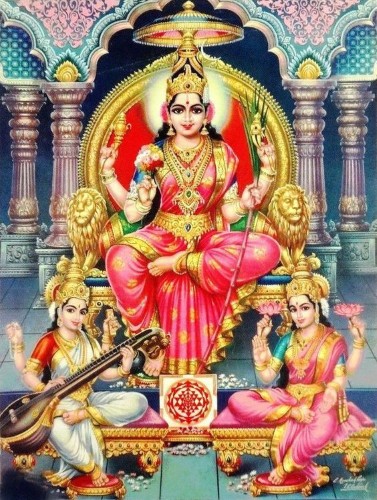
In this 39th verse, Śrī Lalitā appears as the Supreme Kuṇḍalinī Śakti, rising through the higher chakras — from awakening of insight to ultimate liberation.
- At the Ājñā Chakra, She dissolves the Rudra-granthi — the knot of ego, pride, and duality that binds the mind to individuality. Here, She awakens clarity and divine perception, freeing the seeker from the illusion of separateness.
- At the Sahasrāra Chakra, She ascends and blossoms as the thousand-petaled lotus, radiating supreme consciousness. From here, She showers the nectar of immortality (Sudhāsārābhi-varṣiṇī), filling the being with divine bliss, purity, and spiritual fulfillment.
Meditation:
This verse guides us to inner awakening and liberation. The Rudra-granthi represents the subtle ego and mental bondage that obstructs spiritual vision. As Lalitā ascends to the Sahasrāra, She pours the essence of divine bliss, nourishing the soul with immortality and ultimate consciousness.
Meditating on this verse helps us internalize the journey of spiritual ascent:
- Release pride and ego (Rudra-granthi)
- Receive the nectar of divine knowledge and bliss (Sahasrāra)
- Merge into the infinite, experiencing the Mother’s grace in full.
Sanskrit: आज्ञा-चक्रान्तरालस्था
Tamil: ஆஜ்ஞா-சக்ராந்தராளஸ்தா²
Meaning: She who resides in the Ājñā Chakra, the third-eye center between the eyebrows — the subtle meeting point of body (udal) and soul (uyir), where the mind (manam) bridges the five senses and consciousness. Here, She governs intuition, wisdom, and inner command, dissolving duality and revealing the light of truth.
Reflection: As Ājñā-chakrāntarālasthā, the Mother brings mental clarity and peace (mana-amaidhi), healing disturbances and restlessness (mana-noigal). When the mind becomes still, the seeker perceives divine reality beyond thoughts and forms.
Contemporary Reflection: She reminds us that true peace is born within — when the senses, thoughts, and emotions align under the guidance of inner awareness. By meditating on Her between the eyebrows, we awaken intuition, harmony, and spiritual insight.
Meditation: “I bow to the Mother who dwells between the brows, bringing peace to the mind and merging body, life, and soul in divine awareness.”
Sanskrit: रुद्र-ग्रन्थि-विभेदिनी
Tamil: ருத்³ர-க்³ரந்தி²-விபே⁴தி³னீ
Meaning: She who pierces the Rudra-granthi, the final spiritual knot located near the Ājñā Chakra, which binds the soul through ego, duality, and the sense of individuality — “I” and “mine.” At this stage, Śakti (Umā) unites fully with Śiva (Rudra). When She is present with Him, life and vitality flow through the body; when She withdraws, Rudra grants mokṣa — liberation to the soul.
Reflection: As Rudra-grānthi-vibhedinī, She dissolves the last barrier between the seeker and the Divine, merging awareness into pure consciousness. This union symbolizes the harmony of all relationships and energies — body, mind, and soul becoming one.
Contemporary Reflection: She teaches that true unity begins within — when the inner masculine and feminine, logic and love, strength and compassion are balanced. Just as She restores harmony between Śiva and Śakti, She blesses our lives with family unity (kudumba orrumai), understanding, and peace.
Meditation: “I bow to the Mother who breaks the final knot of ego, uniting all opposites and granting both worldly harmony and eternal liberation.”
Sanskrit: सहस्राराम्बुजारूढा
Tamil: ஸஹஸ்ராராம்பு³ஜாரூடா⁴
Meaning: She who is enthroned on the thousand-petalled lotus (Sahasrāra) at the crown of the head — the radiant seat of supreme consciousness where Śiva, the Sun-like circle of pure being, and Śakti, His rays of blissful energy, exist as one. Here, She reigns as the embodiment of Sakala–Niṣkala tattva — both manifest and transcendent, the ultimate union of energy and awareness.
Reflection: As Sahasrārāmbujārūḍhā, She marks the culmination of spiritual ascent, where individual consciousness dissolves into divine light. Meditating on Her at the crown brings mana amaidhi (mental peace), ātmā śuddhi (soul purity), and the grace to overcome all forms of varumai — lack, limitation, or sorrow.
Contemporary Reflection: She reminds us that the highest realization is not escape from life but its illumination — when our thoughts, actions, and awareness all shine with the same divine radiance. When Śiva’s stillness and Śakti’s movement unite within, life itself becomes sacred.
Meditation: "I bow to the Mother seated on the thousand-petalled lotus, radiant as the Sun and His rays, who removes all lack and reveals the fullness of divine bliss.”
Sanskrit: सुधासाराभि-वर्षिणी
Tamil: ஸுதா⁴ஸாராபி⁴-வர்ஷிணீ
Meaning: She who showers the divine nectar (Sudhā) of immortality and bliss — the sacred essence that flows through the subtle channels when the Kuṇḍalinī Śakti rises and unites with Śiva at the crown of the head.
Reflection: After years of steadfast Brahmacharya and discipline, a great inner transformation dawns — body and soul separate in awareness (udal veru, uyir veru), and the nectar of divine energy flows upward to the crown (thalai ucchi), awakening radiant consciousness. This is the blooming of the thousand-petaled lotus — the dawn of devatā dharisanam (divine vision).
Contemporary Reflection: She reminds us that true fulfillment does not come from the outer world, but from the flow of divine grace within. The one who allows this nectar to flow through life becomes a healer, a comforter, and a light of serenity in the world.
Meditation: “May the nectar of Her grace rise within me, transforming every cell into light and every thought into compassion. May Her divine rain cleanse my being and fill me with bliss beyond measure.”
Audio courtesy of The Sanskrit Channel
Video courtesy of Sri Sankara TV YouTube channel