37
Sanskrit:
कुलाङ्गना कुलान्तःस्था कौलिनी कुलयोगिनी ।
अकुला समयान्तःस्था समयाचारतत्परा ॥ ३७ ॥
English:
kulāṅganā kulāntaḥsthā kaulinī kulayōginī |
akulā samayāntaḥsthā samayācāratatparā ॥ 37 ॥
Tamil:
குலாங்க³நா குலாந்த꞉ஸ்தா² கௌலிநீ குலயோகி³நீ ।
அகுலா ஸமயாந்த꞉ஸ்தா² ஸமயாசாரதத்பரா ॥ 37 ॥
Meaning:
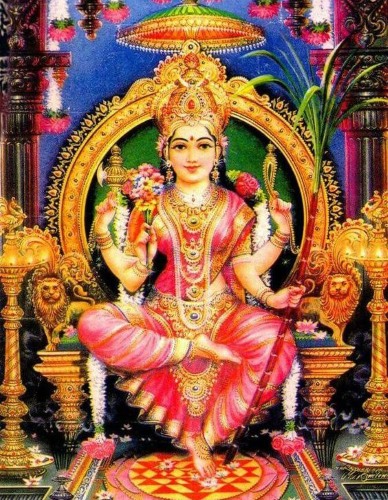
In this 37th verse, Śrī Lalitā appears as:
The Divine Mother as the Supreme Yoginī, both the essence of the Kula path (the external, ritualistic, mantra-based Śrī Vidyā practice) and the transcendent reality beyond Kula (A-kula). She embodies the Kaula path but also abides in the Samaya tradition—the internal, meditative realization of the same truth.
Thus, She is the giver of initiation, the guide of rituals, and the silent presence in meditation, encompassing both outer worship and inner realization.
Meditation:
This verse teaches us that spiritual truth has two dimensions:
- The Kula path, rich in rituals, mantras, and external worship, guiding the aspirant step by step.
- The Samaya path, the inner journey of meditation and self-realization, where the seeker discovers the Mother as pure consciousness.
Ultimately, Lalitā is beyond both—She is A-kula, the reality that rituals point toward and meditation dissolves into. Contemplating Her in this verse leads us to honor both outer devotion and inner silence as complementary aspects of the same truth.
Sanskrit: कुलाङ्गना
Tamil: குலாங்க³னா
Meaning: She who is the supreme woman (Aṅganā) of the Kaula tradition (Kula), embodying its deepest wisdom, power, and grace. She represents the divine feminine principle in its highest form within the sacred path of Śrīvidyā.
Reflection: This name honors the Mother as the essence of divine womanhood — powerful yet nurturing, wise yet compassionate, transcending all limitations.
Contemporary Reflection: She reminds us to honor the feminine divine in every aspect of life — in nature, relationships, and within ourselves, balancing strength with love and wisdom with grace.
Meditation: “I revere the Mother as the supreme divine feminine, the heart of sacred wisdom and power.”
Sanskrit: कुलान्तस्था
Tamil: குலாந்தஸ்தா²
Meaning: She who abides in the deepest core (antaḥstha) of the Kaula tradition (Kula). This signifies her presence in the innermost, most sacred essence of Śrīvidyā worship — subtle, secret, and supremely divine.
Reflection: The Mother dwells in the inner sanctum of the heart, where true devotion and realization blossom beyond external rituals.
Contemporary Reflection: She teaches us to look within for the divine, realizing that the deepest truths are discovered not in noise but in the silence of inner awareness.
Meditation: “I meditate on the Mother who dwells in the deepest sanctum of sacred wisdom and my own heart.”
Sanskrit: कौलिनी
Tamil: கௌளினீ
Meaning: She who embodies the Kaula tradition — the supreme current of spiritual energy, wisdom, and bliss; manifesting as Guhya-vāk, the secret inner speech through which the silent Divine reveals itself; uniting knowledge, devotion, and power in perfect harmony.
Reflection: As Kaulinī, the Mother awakens the secret current of divine consciousness within, guiding the seeker from inner silence to realization. Through her grace, transformation unfolds gently — from ignorance to illumination, through love and compassion.
Contemporary Reflection: She teaches us to weave spiritual awareness into daily living — to let wisdom, devotion, and strength flow naturally in our thoughts, actions, and relationships, turning every moment into an expression of sacred harmony.
Meditation: “I bow to the Mother, Kaulinī — the radiant heart of secret speech, divine wisdom, and bliss.”
Sanskrit: कुलयोगिनी
Tamil: குலயோகி³னீ
Meaning: She who is the Yoginī of the Kaula tradition — perfectly uniting spiritual wisdom, devotion, and inner discipline. As Kulayoginī, she embodies the divine union of knowledge (jñāna) and energy (śakti), awakening the seeker to the sacred harmony of consciousness and power.
Reflection: The Mother as Kulayoginī moves through the currents of life as a liberating force — guiding, protecting, and transforming. In moments of darkness or danger, her presence becomes a shield of divine grace, rescuing the devotee from harm and leading them back to truth.
Contemporary Reflection: She reminds us that true Yoga is not escape, but integration — to balance wisdom with love, strength with humility, and discipline with compassion. By invoking her, we learn to meet challenges with inner clarity and divine courage.
Meditation: “I bow to the Mother, Kulayoginī — the radiant Yoginī who rescues her children through grace, wisdom, and power.”
Sanskrit: अकुला
Tamil: அகுலா
Meaning: She who transcends the Kula — the manifest world and all its forms. As Akulā, the Mother is the boundless reality beyond all dualities, the source from which everything arises and into which all dissolves. She abides above the crown, as pure awareness beyond thought and vibration.
Reflection: The Mother as Akulā reveals the silent summit of consciousness — where the seeker, rising through devotion and knowledge, meets the infinite stillness beyond form. She is the light above the crown, the eternal witness untouched by creation.
Contemporary Reflection: She teaches us to rise beyond attachment and fear, to rest in the awareness that transcends every role and identity. In moments of stillness, we touch her presence — infinite, radiant, and free.
Meditation: “I bow to the Mother, Akulā — the formless One beyond all, who shines above the crown as pure, unbounded consciousness.”
Sanskrit: समयान्तस्था
Tamil: ஸமயாந்தஸ்தா²
Meaning: She who abides in the innermost essence of the Samaya tradition — the sacred path of inner worship in Śrīvidyā, where realization arises through meditation and devotion rather than external ritual. Seated at the still point within the union of the Śiva-koṇa (triangle of consciousness) and Śakti-koṇa (triangle of energy) in the Śrīcakra, She embodies perfect harmony — the radiant center where silence becomes bliss.
Reflection: As Samayāntasthā, the Mother dwells in the heart of every seeker, where Śiva and Śakti unite as pure awareness and vibrant power. When we turn inward to that sacred space, all surrounding currents (suzhalgal) — both within and without — align in harmony, becoming auspicious supports on our spiritual path. She transforms every movement of life into a circle of grace.
Contemporary Reflection: She reminds us that true worship begins within. By resting in awareness and acting with love, we bring balance to our thoughts, emotions, and environments — turning daily life into a living mandala where divine order prevails and peace naturally flows.
Meditation: “I bow to the Mother, Samayāntasthā — the silent heart of inner worship, where Śiva and Śakti shine as one.”
Sanskrit: समयाचार-तत्परा
Tamil: ஸமயாசார-தத்பரா
Meaning: She who is ever absorbed in the Samaya path of inner worship, where the Divine is realized within and adored through meditation and awareness rather than external rites. As the heart’s indwelling presence, She delights in silent devotion, where thought, breath, and being become sacred offerings to Her own radiant self.
Reflection: As Samayācāra-tatparā, the Mother teaches that true pūjā begins within. The inner flame of awareness replaces the lamp, the current of love becomes the abhiṣekam, and every breath becomes mantra. When we turn inward with sincerity, She receives every act as pure worship — no temple or ritual required.
Contemporary Reflection: She reminds us that spirituality is not confined to ritual or form. When mindfulness, compassion, and devotion guide our actions, the Divine is honored in all we do — at work, at home, and in the stillness of our hearts.
Meditation: “I bow to the Mother, Samayācāra-tatparā — She who rejoices in the inner worship where silence itself becomes prayer.”
Audio courtesy of The Sanskrit Channel
Video courtesy of Sri Sankara TV YouTube channel