36
Sanskrit:
मूलमन्त्रात्मिका मूलकूटत्रयकलेबरा ।
कुलामृतैकरसिका कुलसङ्केतपालिनी ॥ ३६ ॥
English:
mūlamantrātmikā mūlakūṭatrayakalēbarā |
kulāmr̥taikarasikā kulasaṅkētapālinī ॥ 36 ॥
Tamil:
மூலமந்த்ராத்மிகா மூலகூடத்ரயகலேப³ரா ।
குலாம்ருதைகரஸிகா குலஸங்கேதபாலிநீ ॥ 36 ॥
Meaning:
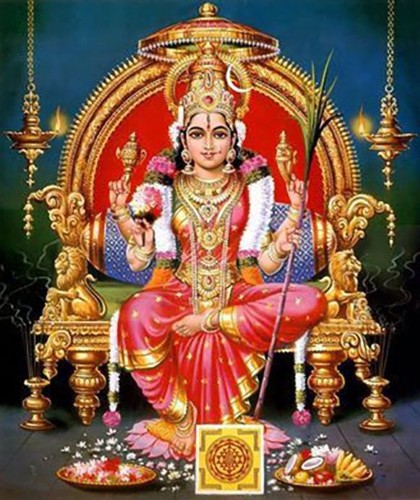
In this 36th verse, Śrī Lalitā appears as:
The living embodiment of the Pañcadaśī Mantra, Her entire being woven from its three sections—wisdom, love, and power. She delights in the nectar of Kula, the mystical union of Śiva and Śakti, representing the highest bliss and spiritual awakening.
As the guardian of the Kula secrets, She protects the sacred knowledge of Śrī Vidyā, ensuring it is revealed only to the worthy—those with devotion, purity, and guidance from the Guru.
Meditation:
This verse invites us to see the Divine Mother not only as a cosmic force but as the living mantra itself. Meditating on Her form is meditating on the Pañcadaśī Mantra; chanting the mantra is invoking Her presence.
Her delight in the nectar of Kula reminds us that spiritual life is not dry or rigid—it is a joyful union of wisdom and love, of Śiva (consciousness) and Śakti (energy). She guards these truths because their power, if misunderstood, can be misused. Approaching Her with humility and devotion opens the doors to this blissful wisdom.
Sanskrit: मूलमन्त्रात्मिका
Tamil: மூலமந்த்ராத்மிகா
Meaning: She who is the very soul (Ātmikā) of the Mūla Mantra, the root mantra (Pañcadaśī or Śrīvidyā mantra) from which all divine powers emerge. She embodies the essence and energy of sacred sound.
Reflection: The Mother as Mūlamantrātmikā reminds us that every sound, every vibration holds creative power when aligned with divine intent.
Contemporary Reflection: In today’s noisy world, this name calls us to pause, chant, or meditate, reconnecting with the root energy of peace and purpose that lies within sacred sounds.
Meditation: “I revere the Mother as the very life-force of the root mantra, the source of divine energy and wisdom.”
Sanskrit: मूलकूटत्रय-कलेबरा
Tamil: மூலகூடத்ரய-களேப³ரா
Meaning: She whose entire form is constituted by the three Kūṭas (sections) of the Pañcadaśī Mantra — Vāgbhava-kūṭa (head/face), Madhya-kūṭa (torso), and Śakti-kūṭa (waist downwards). She embodies the complete power of the mantra in her divine body.
Reflection: This name shows her as the living form of sacred sound and divine energy, integrating knowledge, preservation, and liberation within herself.
Contemporary Reflection: She reminds us that the body, mind, and spirit can be sanctified when aligned with divine consciousness, turning life itself into a sacred mantra.
Meditation: “I bow to the Mother whose entire being radiates the power of the sacred mantra.”
Sanskrit: कुलामृतैक-रसिका
Tamil: குலாம்ருதைக-ரஸிகா
Meaning: She who relishes the nectar of the Kaula path — the spiritual tradition (Kaula) in Śrīvidyā worship that unites knowledge, devotion, and energy. She enjoys the bliss of divine consciousness symbolized as nectar (Amṛta).
Reflection: This name celebrates the Mother as the one who delights in the essence of spiritual bliss and liberation, guiding seekers toward divine ecstasy.
Contemporary Reflection: In a world chasing outer pleasures, she teaches us to seek the inner nectar of joy found in meditation, love, and self-realization rather than fleeting desires.
Meditation: “I honor the Mother who savors the nectar of divine bliss and leads us to taste it within ourselves.”
Sanskrit: कुलसङ्केत-पालिनी
Tamil: குலஸங்கேத-பாலினீ
Meaning: She who protects and preserves the sacred secrets of the Kaula tradition (Śrīvidyā). The Mother safeguards the spiritual truths and practices meant only for worthy and devoted seekers.
Reflection: Not all knowledge is for open display; divine wisdom comes with responsibility and reverence. She teaches discernment in sharing and practicing sacred truths.
Contemporary Reflection: In today’s information age, this name reminds us to value confidentiality, respect boundaries, and honor the sanctity of deep spiritual knowledge.
Meditation: “I bow to the Mother who protects the sacred wisdom and guides seekers with grace and care.”
Audio courtesy of The Sanskrit Channel
Video courtesy of Sri Sankara TV YouTube channel