51
Sanskrit:
दुष्टदूरा दुराचारशमनी दोषवर्जिता ।
सर्वज्ञा सान्द्रकरुणा समानाधिकवर्जिता ॥ ५१ ॥
English:
duṣṭadūrā durācāraśamanī dōṣavarjitā |
sarvajñā sāndrakaruṇā samānādhikavarjitā || 51 ||
Tamil:
து³ஷ்டதூ³ரா து³ராசாரஶமநீ தோ³ஷவர்ஜிதா ।
ஸர்வஜ்ஞா ஸாந்த்³ரகருணா ஸமாநாதி⁴கவர்ஜிதா ॥ 51 ॥
Meaning:
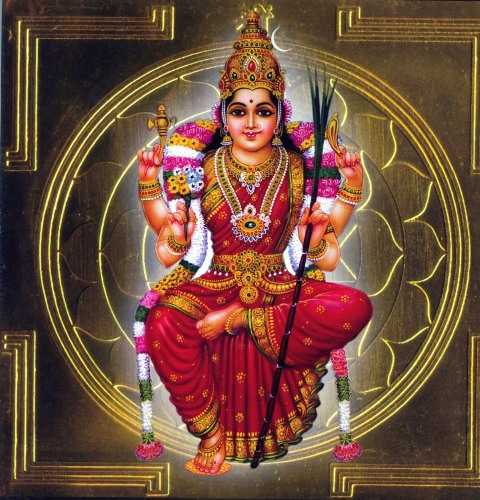
In this verse, Śrī Lalitā appears as the pure, flawless, and supremely compassionate Divine Mother, untouched by any imperfection and beyond all limitation.
As Dōṣa-varjitā, She is free from all defects (dōṣa)— no fault, no stain, no weakness, no impurity can exist in Her. She is absolute purity itself.
As Duṣṭadūrā, She remains far from wickedness and keeps negativity at a distance—not because She rejects anyone cruelly, but because evil cannot stand in the presence of divine light. Dūram means distance, and duṣṭa refers to that which causes suffering. She establishes the sacred order in life: what is good should remain close, and what is harmful should stay far away. This includes outer negativity, but also inner disturbances—such as kāma, krodha, lobha, moha, mada, and mātsarya.
When She is remembered with devotion, troubles and interference begin to withdraw on their own, as if they can no longer remain near the devotee. Yet She is not only a protector—She is also a reformer.
As Durācāra-śamanī, She calms and removes unrighteous conduct. Right conduct (ācāra) is not mere ritual discipline, but the alignment of mind, speech, and body toward dharma and ātma-jñāna. The Mother does not correct with harsh judgment—rather, She removes wrong tendencies and shows compassion (thurācārathai azhithu karuṇai paṇṇuvāḷ). Through Her grace, harmful habits fade naturally and dharma becomes steady again.
She shines as Sarvajñā, the all-knowing consciousness who understands every heart completely.
At the same time, She is Sāndra-karuṇā—compassion in its fullest intensity: soft, forgiving, and deeply protective.
And as Samānādhika-varjitā, She is beyond comparison— no one equals Her, and none surpasses Her (oppāna, mēlānaval yārum illai). Yet, though supreme beyond all hierarchy, She comes in simplicity, blessing devotees with ease. She supports each person’s unique nature (thani-thanmai) to shine, creating the right opportunities for inner goodness and strength to stand firm in life.
Meditation:
This verse reveals Lalitā as the perfect balance of purity, protection, correction, wisdom, and compassion.
Meditate on Her as Dōṣa-varjitā—the flawless purity that cannot be shaken. Her perfection is not cold distance; it is a divine standard that heals and uplifts.
Meditate on Her as Duṣṭadūrā—the Mother who keeps harmful influences far away. She creates a protective boundary around the devotee so that good stays near and negativity stays distant, both externally and internally.
Meditate on Her as Durācāra-śamanī—the gentle power that reforms wrong habits. She does not condemn the devotee; she quietly removes the roots of harmful conduct through compassion.
Meditate on Her as Sarvajñā—the One who knows everything within us. Nothing is hidden from Her, yet nothing is judged with cruelty.
Meditate on Her as Sāndra-karuṇā—compassion in its most intense, healing form. It melts guilt, fear, and harshness, restoring softness and strength.
Meditate on Her as Samānādhika-varjitā—the incomparable Supreme. In Her presence, the mind stops comparing and competing, and instead rests in surrender and peace.
This verse teaches us:
When we turn toward the Mother, She not only protects us from negativity—She purifies us, reforms what is harmful, and fills our life with clarity and compassion.
Sanskrit: दुष्टदूरा
Tamil: துஷ்டதூரா
Meaning: She who keeps negativity, evil, and harmful forces far away. As Duṣṭadūrā, She creates a divine distance between the devotee and all that causes suffering. Here: • Dūram means distance / far away • Duṣṭa refers to harmful, trouble-causing forces—anything that brings pain, disturbance, or destruction.
Reflection: As Duṣṭadūrā, She is the protective Mother who ensures: what is good stays close, and what is harmful stays far. Harm can appear in many forms: For the body: • disease • weakness • laziness or heaviness (somberithanam) For the mind and heart: • kāma (craving/desire) • krodha (anger) • lobha (greed) • moha (delusion/attachment) • mada (pride/intoxication) • mātsarya (jealousy/envy) By praying to fierce protective forms like Kāḷī and Pēcciyamman, all such harmful influences begin to withdraw naturally. Trouble and disturbance do not need to be fought—they move away on their own.
Contemporary Reflection: She inspires moral clarity and inner strength to resist harmful influences. She reminds us that: • not everything deserves closeness • boundaries are sacred protection • inner purity is the strongest shield • negativity weakens when dharma is strong When one remembers Duṣṭadūrā, harmful company, destructive habits, and negative energies begin to lose their hold. Disturbance, sabotage, and unwanted interference gradually distance themselves from the devotee’s life.
Meditation: “I honor Duṣṭadūrā, the Divine Mother who keeps all negativity far away. Let what is good remain near me, and let all harmful forces depart. Protect my body from illness and weakness, protect my mind from desire, anger, greed, and delusion, and establish dharma, strength, and peace within me.”
Sanskrit: दुराचारशमनी
Tamil: துராசார-ஶமனி
Meaning: She who pacifies, removes, and corrects unrighteous conduct. As Durācāra-śamanī, She dissolves harmful behavior and restores the devotee to dharma through grace.
Reflection: As Durācāra-śamanī, She is pōkkupaval / azhippaval—the One who removes wrong conduct at its root. True ācāra (right conduct) is aligning mind (manam), speech (vāku), and body (kāyam) toward ātma-jñāna and a dharmic life. When conduct becomes disturbed, it turns into dur-ācāra—habits and actions that cloud clarity and create suffering. Yet the Mother does not “worry” or “bother” in a harsh, judging way. She simply removes durācāra and shows compassion By Her grace, bad habits begin to fall away naturally, and the heart returns to balance.
Contemporary Reflection: She teaches accountability paired with compassion—correction without hatred. She reminds us that: • change is always possible • correction can be gentle • dharma begins with inner alignment • compassion heals faster than punishment When we pray to Durācāra-śamanī, the mind becomes disciplined, speech becomes cleaner, and actions become purposeful—without inner heaviness or guilt.
Meditation: “I bow to Durācāra-śamanī, the compassionate Mother who removes unrighteous conduct. Without judgment, purify my habits and intentions. Align my mind, speech, and actions with dharma, and guide me gently toward inner wisdom.”
Sanskrit: दोषवर्जिता
Tamil: தோஷவர்ஜிதா
Meaning: She who is free from all defects and imperfections. As Doṣa-varjitā, She is divine completeness—untouched by imbalance, flaw, or limitation.
Reflection: As Doṣa-varjitā, She is flawless in being. Yet, out of compassion, She is also the One who removes defects, shortcomings, and doṣas from the devotee—kuttrathai, kuraivai, doṣathai pōkkubaval. While praying, what inner quality is required? Not complexity—only truth of heart: • Pattru to the Divine Feet (Iraivanudaiya thiruvadi pattru) • Anbu (love and devotion) Many qualities that are unfit for worship—negative attitudes, inner resistance, impurity of intention—become doṣas. The Mother removes these gently, without judgment, and restores purity within.
Contemporary Reflection: She reminds us that perfection lies in essence, not appearance. She teaches us that: • flaws are often habits, not identity • devotion purifies faster than self-blame • love and surrender invite grace • inner defects dissolve in divine presence When we remember Doṣa-varjitā with sincerity, the Goddess comes swiftly before us in grace, and blessings are received quickly and clearly (anugraham viraivāga kidaikkum).
Meditation: “I honor Doṣa-varjitā, the flawless Divine Mother. Remove my defects, shortcomings, and inner doṣas. Give me love, surrender, and steady devotion at Your Feet. Come swiftly with Your grace, and bless me with purity, clarity, and divine completeness.”
Sanskrit: सर्वज्ञा
Tamil: சர்வஜ்ஞா
Meaning: She who knows all — past, present, and future. As Sarvajñā, She is all-knowing consciousness, where nothing is hidden, forgotten, or unknown.
Reflection: As Sarvajñā, She is anaithum arinthaval—the One who knows everything. Human beings can never know everything. Our knowledge is limited, partial, and changing. But the Mother’s knowing is not gathered slowly—it is complete, effortless, and eternal. She is the true measure of wisdom—the very fullness of jñāna (jñānathin aḷavukōl). In Her presence, ignorance dissolves and insight awakens. Those who feel stuck in manda nilai (dullness, low clarity), or who lack sharpness and confidence (sādhuryam illāmal iruppathu), are especially uplifted by Her grace.
Contemporary Reflection: She teaches trust in a wisdom greater than personal understanding. She reminds us that: • we don’t need to know everything to be guided rightly • divine wisdom sees what the mind cannot • clarity is a gift that can be awakened • growth begins when we surrender arrogance and fear By remembering Sarvajñā, She grants puthunarchi (renewal), arivu-unarvu (awakened intelligence), inner blossoming, and the strength to live with samarthiyam (competence and capability).
Meditation: “I bow to Sarvajñā, the all-knowing Divine Mother. You who see past, present, and future, guide me with Your perfect wisdom. Remove dullness and confusion from my mind, grant me renewed intelligence and inner blossoming, and make me capable, confident, and steady through Your grace.”
Sanskrit: सान्द्रकरुणा
Tamil: சாந்த்ரகருணா
Meaning: She who is compassion condensed into form. As Sāndrakaruṇā, She is mercy itself made visible—pure compassion in living presence.
Reflection: As Sāndrakaruṇā, She is idaividātha karuṇai—unbroken compassion, and miguntha karuṇai—abundant, overflowing mercy. She never becomes tired of blessing. In granting grace, She does not hesitate or withdraw—anugraham paṇṇuvathil salikka māṭṭāḷ. The Mother is not merely compassionate in action— Her very form is compassion (vadivamē karuṇai). Whatever is asked with sincerity, She fulfills in the way that is truly beneficial.
Contemporary Reflection: She inspires deep empathy and compassionate action. She reminds us that: • kindness is divine strength • grace flows where the heart is sincere • compassion heals relationships faster than arguments • mercy opens doors that force cannot By remembering Sāndrakaruṇā, even disturbances from superiors or authorities (mēl-adhikāri thondaravu) can soften. A better connection forms, trust grows, and even friendship-like goodwill can arise—bringing harmony and support in professional life.
Meditation: “I honor Sāndrakaruṇā, compassion incarnate. Let Your unbroken mercy flow through my life. Bless me without hesitation, soften conflicts and harshness around me, and grant me harmonious relationships, especially with those in authority. May Your very compassion become my refuge and strength.”
Sanskrit: समानाधिकवर्जिता
Tamil: சமாநாதிகவர்ஜிதா
Meaning: She who has no equal and no superior—the absolute Supreme. As Samānādhika-varjitā, there is none comparable (samāna) to Her, and none above Her (adhika). She stands beyond all hierarchy and measurement.
Reflection: As Samānādhika-varjitā, She is the One for whom there is no equal and no greater—oppāna, mēlānaval yārum illai). Yet, though supreme beyond all comparison, the Mother does not remain distant. She comes with simplicity and tenderness, blessing devotees easily—Ambal arrives in a humble, accessible way and grants grace. She recognizes the unique nature (thani-thanmai) in every being, and through Her compassion, She creates opportunities for that inner goodness and strength to shine and stand firm in life.
Contemporary Reflection: She invites surrender to the ultimate reality beyond ego and evaluation. She reminds us that: • comparison weakens peace • the Supreme cannot be measured by the mind • grace can be simple and immediate • each person’s unique path can blossom through divine support When we surrender to Her, the need to prove, compete, or evaluate fades. In its place arises confidence, dignity, and a quiet sense of being guided.
Meditation: “I bow to Samānādhika-varjitā, the incomparable Supreme Mother. Though none is equal or higher than You, come to me in simplicity and bless me. Help my true nature shine without fear, open the right opportunities in my life, and keep me steady in surrender, peace, and grace.”
Audio courtesy of The Sanskrit Channel
Video courtesy of Sri Sankara TV YouTube channel