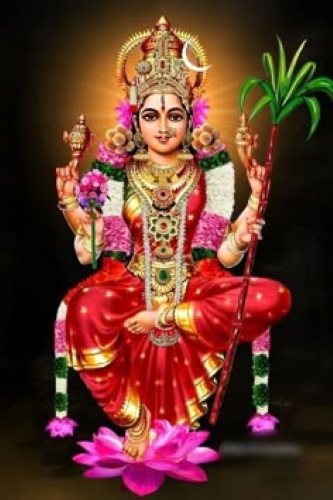
50
Sanskrit:
निस्तुला नीलचिकुरा निरपाया निरत्यया ।
दुर्लभा दुर्गमा दुर्गा दुःखहन्त्री सुखप्रदा ॥ ५० ॥
English:
nistulā nīlacikurā nirapāyā niratyayā |
durlabhā durgamā durgā duḥkhahantrī sukhapradā ॥ 50 ॥
Tamil:
நிஸ்துலா நீலசிகுரா நிரபாயா நிரத்யயா ।
து³ர்லபா⁴ து³ர்க³மா து³ர்கா³ து³꞉க²ஹந்த்ரீ ஸுக²ப்ரதா³ ॥ 50 ॥
Meaning:
In this 50th verse, Śrī Lalitā appears as the incomparable and invincible Divine Mother—the One who is beyond all measure, beyond all fear, and beyond all limitation.
She is:
- Nistulā — incomparable, beyond any equal or comparison
- Nīlacikurā — the Mother whose deep blue-black hair symbolizes the infinite cosmic depth, mystery, and timeless power
- Nirapāyā — the unfailing refuge of absolute safety, protecting the devotee from danger and adverse forces
- Niratyayā — the One who never fails, whose grace is steady and flawless, and whose support does not withdraw
Yet She is also:
- Durlabhā — difficult to attain through mere intellect, ego, or pride
- Durgamā — hard to cross or reach, because the mind cannot “capture” Her with effort alone
- Durgā — the compassionate Mother who becomes reachable through surrender, and who destroys obstacles with fierce love
And finally, She reveals Her tender, healing power as:
- Duḥkhahantrī — remover of sorrow, grief, pain, and inner turmoil
- Sukhapradā — bestower of joy, peace, harmony, and lasting contentment
Thus, Lalitā is the Mother who protects, liberates, and blesses in equal measure—not only guarding life from danger, but also transforming the inner world into peace.
Meditation:
This verse teaches that the Mother is both:
- cosmic transcendence (beyond comparison, beyond reach), and
- intimate protection (closer than our own breath)
Though She is Nistulā, beyond all measure, and Durlabhā, not easily grasped by the mind, She becomes completely near to the devotee through love and surrender.
Meditate on Her as Nirapāyā—your safe refuge in every danger. When life feels threatened, unstable, or uncertain, She becomes the ground that cannot collapse.
Meditate on Her as Niratyayā—the unfailing presence. Even if people criticize, misunderstand, or doubt you, Her grace ensures steadiness, progress, and completion.
Meditate on Her as Durgā—the fierce compassionate Mother. She stands beside you, cutting down obstacles and transforming hostile situations into favorable conditions.
Meditate on Her as Duḥkhahantrī—the One who wipes tears from the heart. She removes not only outer pain, but the inner causes of suffering: fear, confusion, agitation, and heaviness.
Meditate on Her as Sukhapradā—the giver of lasting joy. She grants happiness that does not depend on events, praise, or gain—but arises from harmony, clarity, and the quiet fullness of grace.
This verse invites you to rest in Her protection, trust Her guidance,and experience the deep joy of being held by the Mother.
Sanskrit: निस्तुला
Tamil: நிஸ்துலா
Meaning: She who is incomparable — without equal or parallel.
Reflection: As Nistulā, She transcends comparison and measurement. Nothing can be placed beside Her for evaluation. By saying this, everything will happen so fast and so quick.
Contemporary Reflection: She reminds us to stop measuring ourselves against others and recognize inherent worth beyond comparison.
Meditation: “I bow to Nistulā, the incomparable divine presence.”
Sanskrit: नीलचिकुरा
Tamil: நீலசிகுரா
Meaning: She who has long, flowing hair, not merely a physical attribute, but a profound symbol of infinity, mystery, and unfathomable depth.
Reflection: As Nīlacikurā, Her flowing dark tresses resemble the vast night sky—silent, expansive, and full of unseen power. Her hair holds the stillness of the cosmos before creation, where all possibilities rest in quiet potential. This form reminds us that depth need not be loud and power need not be visible.
Contemporary Reflection: As Nīlacikurā, Her flowing dark tresses resemble the vast night sky—silent, expansive, and full of unseen power. Her hair holds the stillness of the cosmos before creation, where all possibilities rest in quiet potential. This form reminds us that depth need not be loud and power need not be visible. 💫 Contemporary Reflection: In today’s world of instant clarity and surface-level impressions, Nīlacikurā invites us to: • Trust the unknown • Value inner depth over outer display • Find beauty in stillness and silence She teaches that what is deeply rooted naturally commands respect and love.
Meditation: “I honor Nīlacikurā, whose silent depth mirrors the Infinite, and whose grace draws love without effort.”
Sanskrit: निरपाया
Tamil: நிரபாயா
Meaning: She who is free from decline, loss, or decay. As Nirapāyā, She is untouched by harm or deterioration and remains eternally stable, unwavering in all conditions.
Reflection: As Nirapāyā, She is bādhippu illāthaval—the One who is never affected or weakened by any force. No circumstance, danger, or adversity can disturb Her nature. She is the Divine Mother who protects in times of peril, guarding Her devotees from danger (ābathu), and transforming threatening situations through grace. She does not merely shield—She changes the very environment, turning danger into safety, and uncertainty into support.
Contemporary Reflection: She assures us of an inner refuge that remains stable even when external supports fail. She reminds us that: • true security comes from divine protection • harm cannot touch what is held in grace • adverse conditions can be transformed • protection brings confidence and success By Her grace: 1. Victory in legal matters tilts in our favor 2. Success in competitions and examinations is attained 3. Protection from negative influences such as harmful intentions or occult disturbances is ensured 4. Safety in times of danger is firmly established Dangerous situations soften, hostile circumstances dissolve, and a peaceful, favorable environment emerges.
Meditation: “I bow to Nirapāyā, the unfailing Divine Mother. You who are untouched by harm, protect me from danger and adversity. Turn threatening situations into peace, grant safety, victory, and confidence, and establish Your steady grace as the foundation of my life.”
Sanskrit: निरत्यया
Tamil: நிரத்யயா
Meaning: She who never falters, fails, or goes astray. As Niratyayā, Her grace is steady, reliable, and unwavering—never absent, never withdrawn.
Reflection: As Niratyayā, She is kuttram, kurrai illāthaval—the One without fault or deficiency. In Her, there is no error, no lapse, no inconsistency. Finding fault (kurrai solluthal) is a tendency of the human mind, born of comparison, insecurity, or limited vision. The Divine Mother stands beyond such judgments. When one remembers Niratyayā, the power of criticism weakens, misunderstandings dissolve, and clarity replaces confusion. Her grace ensures that what must be accomplished is accomplished, without deviation or breakdown.
Contemporary Reflection: She nurtures trust and perseverance, reminding us that sincere effort is always supported. She teaches us that: • human criticism does not define truth • steadiness overcomes doubt and delay • grace corrects what effort alone cannot • consistency brings recognition By invoking Niratyayā, even those who initially find fault begin to recognize effort and value. Work progresses smoothly, results improve, and appreciation replaces criticism.
Meditation: “I honor Niratyayā, the unfailing Divine Mother. Where doubt, fault-finding, or hesitation arises, establish Your steady grace. Let my efforts unfold without failure, transform criticism into understanding, and guide my actions to successful completion, supported always by Your constant presence.”
Sanskrit: दुर्लभा
Tamil: துர்லபா
Meaning: She who is difficult to attain—not because She is distant, but because She requires sincerity, humility, and inner readiness. As Durlabhā, She is not obtained easily by effort alone.
Reflection: As Durlabhā, She is not something anyone can acquire casually or claim by entitlement. She is not grasped—She is revealed. There are two divine modes in Her grace: • Saulabhyam — where She appears with simplicity, coming close with motherly ease. • Gāmbhīryam — where She remains profound and difficult to attain, responding only to deep tapas and maturity Ultimately, it is not effort alone, but the Mother’s compassion that grants realization. Grace is not forced—it is bestowed.
Contemporary Reflection: She teaches patience, humility, and depth over haste in spiritual pursuit. She reminds us that: • sincerity matters more than speed • ego delays what humility attracts • grace can shorten even long processes • true blessing is immediate when readiness is complete By Her mercy, long-drawn struggles can be compressed, delays can dissolve, and what seemed distant can unfold swiftly. She has the power to condense time—to grant immediate grace where prolonged effort once seemed necessary.
Meditation: “I bow to Durlabhā, the Divine Mother attained through sincerity alone. Soften my ego and mature my devotion. By Your compassion, shorten my struggles, grant swift completion where delay persists, and reveal Yourself—not as something to be attained, but as grace freely given.”
Sanskrit: दुर्गमा
Tamil: துர்கமா
Meaning: She who is difficult to approach and comprehend. As Durgamā, She cannot be easily reached by intellect alone or grasped through explanation. Her depth exceeds language and logic.
Reflection: As Durgamā, She does not allow casual nearness. Those who approach without sincerity find distance, while those who live in goodness and right intention find Her close and protective. She transcends intellectual mastery and demands surrender over analysis. Her presence is not negotiated—it is revealed to the deserving heart. As Durgamā, She stands firm against all opposition. No matter how great the resistance, She breaks through obstacles, burns away threats, and reveals a clear, unobstructed path forward.
Contemporary Reflection: She reminds us that not everything meaningful can be fully explained—some truths must be lived, trusted, and surrendered to. She teaches us that: • sincerity determines closeness • goodness attracts protection • resistance cannot overpower grace • clarity emerges after surrender By Her grace, even overwhelming opposition is neutralized, confusion clears, and suffering dissolves in a moment. Where fear dominates, She establishes courage. Where chaos prevails, She reveals direction.
Meditation: “I honor Durgamā, the Divine Mother beyond easy understanding. Keep me close through sincerity and right action. Protect me against all opposition, remove my suffering in an instant, and reveal a clear path guided by Your unwavering grace.”
Sanskrit: दुर्गा
Tamil: துர்கா
Meaning: She who removes difficulties and protects devotees from danger. As Durgā, She is the invincible power that destroys obstacles and safeguards righteousness.
Reflection: As Durgā, She is fierce compassion—unyielding toward injustice, yet deeply protective toward the sincere. She does not merely shield; She confronts and overcomes what threatens balance and order. She is revealed within the Pañcakōśṭham of Sadāśiva, the five-faced form: Īśānam, Tatpuruṣam, Aghōram, Vāmadevam (Durgā), and Sadyojātam. Here, Durgā stands as Vāmadeva Śakti—the sustaining, protecting force. She is the unified form of all deities (samasta dēvatā ēkaīkiya svarūpam), appearing in the ancient Tamil tradition as Koṟṟavai, the guardian Goddess of the pālai (arid lands),protecting those who traverse hardship, danger, and uncertainty.
Contemporary Reflection: She empowers courage, especially where fear, injustice, and adversity arise. She reminds us that: • protection arises from righteous alignment • courage grows through divine assurance • harmful forces can be reduced and destroyed • positive forces can be strengthened and clarified Lighting a deepa during Rāhu Kālam invokes Her protective force. By Her grace: • negative influences are reduced and destroyed • positive forces are amplified • confusion is removed and clarity restored • desired outcomes (kāmya phala) are granted She strengthens the power of vows, words, and actions, making inner resolve effective and purposeful.
Meditation: “I bow to Durgā, the invincible Divine Mother. You who stand as the unified power of all deities, protect me through courage and clarity. Reduce and destroy all harmful forces, strengthen what is righteous within me, remove confusion, and grant the fruits of sincere effort.”
Sanskrit: दुःखहन्त्री
Tamil: துக்கஹந்திரி
Meaning: She who destroys sorrow at its root. As Duḥkhahantrī, She removes not only visible pain, but also the hidden causes that generate suffering again and again.
Reflection: As Duḥkhahantrī, She is thukkathai azhippaval—the One who destroys sorrow. Sorrow is not only tears or sadness. It can arise in many forms: • the pain of separation that feels unbearable • pressure of responsibilities and unfinished goals • illness and weakness • anger and inner agitation • poverty and insecurity • not knowing the right path • enmity, betrayal, and deceit • hunger and helplessness • guilt and sin that create heaviness • many tasks remaining pending • excessive attachment and delusion • comparison and self-doubt • karmic burden (oozh vinai) • fear of death and the threat of Yama The Mother does not simply comfort—She cuts sorrow at the root, and restores strength, direction, and inner stability.
Contemporary Reflection: She comforts wounded hearts and restores hope through understanding and grace. She reminds us that: • sorrow is real, but it is not permanent • grace can lift what the mind cannot carry • clarity can replace confusion • strength can return even after collapse When we pray to Durgā as Duḥkhahantrī, She can remove suffering quickly and decisively, bringing immediate relief and renewed courage. Traditionally, praying during Rāhu Kālam with sincerity is believed to intensify protection and removal of obstacles, especially for those facing heavy distress.
Meditation: “I honor Duḥkhahantrī, the Divine Mother who removes sorrow. Lift my burdens, heal my pain, and destroy the roots of suffering within me. O Durgā Devī, guide me to the right path, remove illness, fear, poverty, and confusion, and fill my life with strength, clarity, and hope.”
Sanskrit: सुखप्रदा
Tamil: சுகப்ரதா
Meaning: She who bestows happiness and inner contentment. As Sukhapradā, She grants true sukha—joy that is steady, nourishing, and rooted in harmony, not dependent on external gain.
Reflection: As Sukhapradā, She is the Mother who gives nirandhara nanmai—continuous goodness. This goodness is not mixed with harm or sorrow; it is theethilla nanmai—pure, faultless blessing. All such goodness itself becomes sukham. Not only comfort, but well-being, peace, and fullness. She is the One who can gather and pour blessings in abundance, like a Mother who does not measure love, but gives generously and completely. Through Her grace, the devotee receives both inner happiness and outer harmony.
Contemporary Reflection: She reminds us that joy is a natural state when we align with truth. She teaches us that: • happiness grows when the heart is in harmony • lasting joy comes from inner alignment • goodness without fear becomes true prosperity • grace can fill life with abundance As Sukhapradā, She can bestow sixteen kinds of great blessings (padhinaaru perum), and pour forth every form of sukha—so life becomes lighter, brighter, and more meaningful. Our role is to receive with faith, gratitude, and sincerity, and to strive to live worthy of Her blessings.
Meditation: “I bow to Sukhapradā, the Divine Mother who bestows lasting joy. Grant me continuous, pure goodness, free from harm and sorrow. Pour Your blessings upon my life, fill my heart with contentment, and let Your grace become the source of all happiness within and around me.”
Audio courtesy of The Sanskrit Channel
Video courtesy of Sri Sankara TV YouTube channel