46
Sanskrit:
निष्कारणा निष्कलङ्का निरुपाधिर्निरीश्वरा ।
नीरागा रागमथनी निर्मदा मदनाशिनी ॥ ४६ ॥
English:
niṣkāraṇā niṣkalaṅkā nirupādhir nirīśvarā |
nīrāgā rāgamathanī nirmadā madanāśinī ॥ 46 ॥
Tamil:
நிஷ்காரணா நிஷ்களங்கா நிருபாதி⁴ர் நிரீஶ்வரா ।
நீராகா³ ராக³மத²நீ நிர்மதா³ மத³நாஶிநீ ॥ 46 ॥
Meaning:
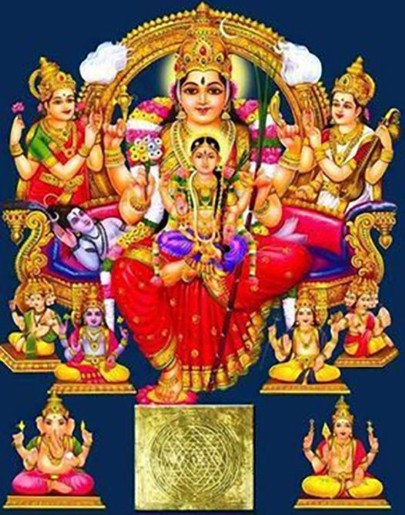
In this 46th verse, Śrī Lalitā appears as:
The Supreme, self-existent Divine Mother, who has no cause, no blemish, no limitation, and no authority above Her.
As niṣkāraṇā, She exists without origin or reason — absolute Reality that simply IS.
As niṣkalaṅkā, She is eternally pure, removing all false blame, inner stain, and outer stigma.
As nirupādhī, She stands beyond all conditions, identities, and dualities of pleasure and pain.
As nirīśvarā, She is the sovereign power — not ruled by any force, yet ruling all through compassion.
At the same time, She works within the seeker as the inner purifier:
- As nīrāgā, She is desireless, untouched by attachment.
- As rāga-mathanī, She churns and dissolves emotional attachment and unhealthy attraction.
- As nirmadā, She removes ego, arrogance, intoxication of pride, and mental imbalance, restoring humility and clarity.
- As madanāśinī, She destroys lust, delusion, and compulsive impulses, freeing the mind from harmful habits.
Thus, Lalitā stands here as both transcendence and transformation — beyond the world, yet actively purifying the aspirant within the world.
She does not suppress desire or ego violently;
She burns illusion through clarity, turning weakness into wisdom.
Meditation:
This verse reveals the Mother as the Supreme Purifier and Liberator.
Meditating on Lalitā as niṣkāraṇā, we recognize that true divinity needs no cause, proof, or origin — it exists beyond logic and time.
As nirupādhī, She awakens us to our own unconditioned awareness beneath name, role, and personality.
As nirīśvarā, She instills inner sovereignty — freedom from fear, dependency, and submission to inner weakness.
As rāga-mathanī and madanāśinī, She becomes the inner fire that dissolves:
- emotional craving
- unhealthy attraction
- ego-driven impulses
- destructive habits
As nirmadā, She removes the “nāan” (ego-sense), restoring humility, dignity, mental balance, and harmony in relationships.
Meditation on this verse gently but powerfully leads the seeker toward:
- freedom from craving
• freedom from ego and pride
• freedom from emotional bondage
• clarity of mind and intention
• inner discipline without suppression
• stable awareness and self-mastery
Sanskrit: निष्कारणा
Tamil: நிஷ்காரணா
Meaning: She who acts without cause, the one whose grace, compassion, and creation arise from her own divine will, not dependent on any reason or condition.
Reflection: As Niṣkāraṇā, She represents the boundless, unconditional nature of the Divine — giving, sustaining, and uplifting without expectation or motive. Her actions are pure expressions of cosmic love and spontaneous benevolence.
Contemporary Reflection: She inspires us to practice unconditional kindness — to do good without seeking recognition, to love without bargaining, and to serve without expecting return. True compassion flows from the heart, just as Her grace flows to all beings.
Meditation: “I bow to Niṣkāraṇā, the cause-less giver, whose unconditional grace teaches me to love and serve without expectation.”
Sanskrit: निष्कलङ्का
Tamil: நிஷ்கலங்கா
Meaning: She who is flawless and stainless — untouched by any imperfection or impurity.
Reflection: As Niṣkalaṅkā, She reveals that purity is the true nature of the soul. All blemishes are temporary shadows — not our identity. Her presence removes the heaviness of self-blame, doubt, and false judgments.
Contemporary Reflection: In daily life, Her grace manifests as: • removal of stigma, • clearing of false accusations, • restoration of reputation, • healing of misunderstandings, • and rebuilding of self-respect and dignity. She also teaches us to see ourselves with compassion, not through the lens of guilt or others’ opinions.
Meditation: “I bow to Niṣkalaṅkā, the stainless Mother who removes undeserved blame, clears my path of misunderstanding, and restores my good name with her pure light.”
Sanskrit: निरुपाधिः
Tamil: நிருபாதிஃ
Meaning: She who is free from all limitations, conditions, and attributes.
Reflection: As Nirupādhiḥ, She reveals the state of absolute freedom. She shows that we are not the labels we carry, nor the roles we play, nor the emotions that overwhelm us. We are the pure awareness beneath them.
Contemporary Reflection: She teaches us to transcend: • self-imposed boundaries, • limiting beliefs, • emotional conditioning, • fear-based identity, • and societal labels. Her grace expands our potential. She helps us become what we truly are — not what the world says we are. Her blessings often come subtly — sometimes through reams, where the mind is open and receptive.
Meditation: “I bow to Nirupādhiḥ, the unconditioned Mother, who frees me from all restriction, guides me even in dreams, and reveals my limitless nature.”
Sanskrit: नीरीश्वराः
Tamil: நீரீஶ்வரா
Meaning: She who is not ruled by any higher power — the Supreme Being Herself, the source and ruler of all that exists.
Reflection: As Nīriśvarā, She embodies ultimate sovereignty. She answers to no one, yet compassionately supports all beings. She is the mother, queen, and ruler of the universe.
Contemporary Reflection: She teaches us: • to take responsibility for our choices, • to lead ourselves with clarity, • to stand independently, • and to cultivate inner authority. Her grace empowers us in both spiritual and material life. Her message: “Do not hand your power to fear — the Divine within you is sovereign.”
Meditation: “I bow to Nīriśvarā, the Supreme Mother, pratyakṣa-śakti of all worlds, who grants wealth, fulfillment, and when united with Śiva, bestows the highest wisdom.”
Sanskrit: निर्गागा
Tamil: நீராகா
Meaning: She who is free from passion, craving, and attachment.
Reflection: As Nīrāgā, She teaches that true peace is not the absence of life, but the absence of inner agitation. She is the calm center where emotions dissolve into clarity.
Contemporary Reflection: As Nīrāgā, She teaches that true peace is not the absence of life, but the absence of inner agitation. She is the calm center where emotions dissolve into clarity. 💫 Contemporary Reflection: In modern life, She helps us: • regulate desire without suppression, • enjoy without addiction, • aspire without obsession, • and live without inner turbulence. Her grace heals restless craving and transforms desire into purpose.
Meditation: “I honor Nīrāgā, the passionless Mother, who frees me from restless craving, balances my emotions, and fulfills my rightful desires with grace.”
Sanskrit: रागमथनी
Tamil: ராகமதனி
Meaning: She who churns, dissolves, and ultimately destroys attachment and craving. As Rāgamathanī, She transforms desire by refining it, revealing its truth, and freeing the soul from its bondage.
Reflection: As Rāgamathanī, She does not merely suppress desire — She churns it, exposes its root, and dissolves its hold over the mind. She teaches that freedom comes not by fighting desire, but by understanding it deeply.
Contemporary Reflection: As Rāgamathanī, She does not merely suppress desire — She churns it, exposes its root, and dissolves its hold over the mind. She teaches that freedom comes not by fighting desire, but by understanding it deeply. 💫 Contemporary Reflection: In modern life, She helps us: • uproot unhealthy attachments, • break obsessive patterns, • restore mental clarity, • and act with inner unity rather than conflict. Her grace brings consensus of thought, ending inner arguments and emotional confusion.
Meditation: “I bow to Rāgamathanī, the Mother who churns desire into wisdom, removes attachment from my heart, and grants me clarity, unity, and peace.”
Sanskrit: निर्मदा
Tamil: நிர்மதா
Meaning: She who is without pride, arrogance, or the intoxication of ego.
Reflection: As Nirmadā, She represents true humility: strength without arrogance, power without domination, clarity without self-importance. Her humility is the highest form of wisdom, because it keeps the mind open, receptive, and compassionate.
Contemporary Reflection: Nirmadā teaches us: • to know our worth without ego, • to be confident without arrogance, • to be joyful without losing balance, • to be powerful without hurting others, • and to stay composed even when success comes. She clears emotional intoxication, removes mental fog, and anchors us in dignity and maturity. Her grace restores mental wellness, humility, self-awareness, and family harmony.
Meditation: “I honor Nirmadā, the egoless Mother, who removes all pride, softens my heart with humility, and fills my home with dignity and harmony.”
Sanskrit: मदनाशिनी
Tamil: மதனாஶினி
Meaning: She who destroys desire and delusion arising from sensual attraction.
Reflection: As Madanāśinī, She is the sacred fire that consumes false pleasure and ego-born pride. She does not suppress desire violently — She transforms it into clarity.
Contemporary Reflection: In modern life, temptations are subtle and constant. Madanāśinī empowers us to: • break free from addictive or destructive habits, • overcome ego-driven desires, • regain control over impulses, • walk the path of purpose with dignity. Her grace replaces craving with contentment and confusion with inner strength.
Meditation: “I bow to Madanāśinī, the Mother who destroys delusion, burns harmful desires, and restores clarity, discipline, and inner freedom.”
Audio courtesy of The Sanskrit Channel
Video courtesy of Sri Sankara TV YouTube channel