45
Sanskrit:
नित्यमुक्ता निर्विकारा निष्प्रपञ्चा निराश्रया ।
नित्यशुद्धा नित्यबुद्धा निरवद्या निरन्तरा ॥ ४५ ॥
English:
nityamuktā nirvikārā niṣprapañcā nirāśrayā |
nityaśuddhā nityabuddhā niravadyā nirantarā ॥ 45 ॥
Tamil:
நித்யமுக்தா நிர்விகாரா நிஷ்ப்ரபஞ்சா நிராஶ்ரயா ।
நித்யஶுத்³தா⁴ நித்யபு³த்³தா⁴ நிரவத்³யா நிரந்தரா ॥ 45 ॥
Meaning:
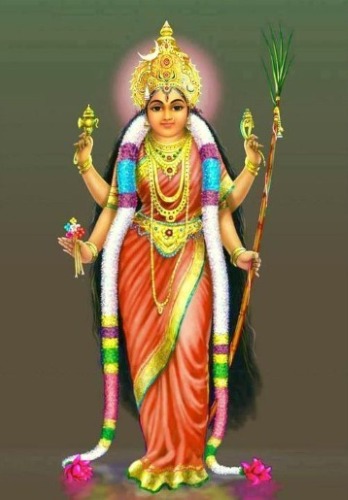
In this 45th verse, Śrī Lalitā appears as:
The eternal, unchanging, all-pervading Supreme Consciousness, free from bondage, untouched by the world, and needing no external support. She is the pure essence of knowledge, purity, and perfection, present continuously in all states and at all times.
Here, Lalitā is seen not just as the Divine Mother with form but as the ever-liberated, ever-present Reality—the substratum of existence and the light of pure awareness in every being.
Meditation:
Meditating on this verse reveals the Divine Mother as the inner Self, untouched by the changing world.
- She is eternally free—reminding us that freedom is not something to gain; it is our original nature.
- She is unchanging—guiding us inward to that still center untouched by life’s turbulence.
- She is beyond creation—teaching that the Highest Truth exists before, during, and after all phenomena.
- She is ever-pure, ever-awake—the radiant consciousness present in every moment.
As nirantarā, She is the continuous presence in our breath, awareness, and being.
This verse teaches that when we quiet the mind, we can experience the Mother not as a distant deity but as the ever-liberated consciousness shining within us.
Sanskrit: नित्य-मुक्ता
Tamil: நித்ய-முக்தா
Meaning: She who is eternally free, beyond bondage of time, circumstance, karma, or limitation.
Reflection: As Nitya-muktā, She reveals the truth that the soul is inherently free, ever untouched by worldly confinement. Her presence dissolves chains — fear, attachment, insecurity - and brings the seeker into the light of inner liberation.
Contemporary Reflection: In modern life, we are often imprisoned not by outer walls, but by: • expectations, • anxieties, • emotional entanglement, • self-doubt, • karmic heaviness. Nitya-muktā frees us from these invisible chains. She teaches us that liberation begins in the mind and heart, long before it appears in circumstances.
Meditation: “I bow to Nitya-muktā, the eternally free Mother, who removes all bondage, clears obstacles, and awakens the limitless freedom within me.”
Sanskrit: निर्विकारा
Tamil: நிர்விகாரா
Meaning: She who is free from all change or modification — the still, eternal, unaltered Divine essence.
Reflection: As Nirvikārā, She reveals that while the world constantly shifts, there is a Presence within us that never changes. She is the silent witness behind all movement, and the eternal truth beneath all appearances.
Contemporary Reflection: In a constantly changing world, She teaches us to anchor ourselves in what is timeless: • values, • integrity, • truth, • spiritual clarity. Her grace gives stability in career, dignity, reputation, and prosperity, protecting what is good and keeping it long-lasting.
Meditation: “I bow to Nirvikārā, the changeless and eternal Mother, who preserves my peace, my dignity, and my blessings.”
Sanskrit: निष्प्रपञ्चा
Tamil: நிஷ்ப்ரபஞ்சா
Meaning: She who transcends the entire manifested universe — beyond illusion, beyond matter, beyond the play of creation.
Reflection: As Niṣprapañcā, She is the silence before the first sound, the stillness before the first movement.
Contemporary Reflection: She teaches us to rise above the fluctuations of life — to see beyond appearances, beyond problems, beyond temporary changes. Her grace provides: • mental transcendence, • clarity to choose the right environment, • support in creating stable living conditions, • and blessings for property, land, and home.
Meditation: “I honor Niṣprapañcā, the transcendent Mother beyond the universe, who removes worldly constraints and reveals the limitless reality within.”
Sanskrit: निराश्रया
Tamil: நிராஶ்ரயா
Meaning: She who depends on none — the self-existent, self-sustaining Source.
Reflection: As Nirāśrayā, She reveals that true power arises not from external support, but from the inner Divine residing within. She is the silent strength behind all beings, empowering us to stand firm even when the world seems unstable.
Contemporary Reflection: Nirāśrayā teaches independence, clarity, and inner confidence: • to trust our inner guidance, • to rely on truth rather than fear, • to act without depending on others’ approval, • to stand strong during legal or difficult situations. Her presence aligns events so that justice is seen, confusion is cleared, and obstacles dissolve.
Meditation: “I bow to Nirāśrayā, the self-sustaining Mother, who frees me from dependence, strengthens my spirit, and brings swift, successful resolution to all my challenges.”
Sanskrit: नित्य-शुद्धा
Tamil: நித்ய-ஶுத்³தா⁴
Meaning: She who is eternally pure, untouched by sin, ignorance, limitation, or impurity.
Reflection: As Nitya-śuddhā, She shows that beneath all flaws, mistakes, and confusions, there is an unchanging core of divine purity in every being. Meditating on Her cleanses the mind, purifies intention, and restores inner light.
Contemporary Reflection: In daily life, Her energy brings: • clarity in decisions, • purity in thought, • discipline in financial habits, • and stability in income and expenses. She reminds us that when the inner mind is pure, outer life begins to fall into natural order — including finances and prosperity.
Meditation: “I honor Nitya-śuddhā, the eternally pure Mother, who purifies my heart, stabilizes my life, and blesses me with clarity and prosperity.”
Sanskrit: नित्य-बुद्धा
Tamil: நித்ய-பு³த்³தா⁴
Meaning: She who is eternally awakened — the pure consciousness that never sleeps and never dims.
Reflection: As Nitya-buddhā, She reminds us that true awakening is not about the eyes being open, but about the mind being clear, aware, alert, intentional, and wise.
Contemporary Reflection: In daily life, Her grace manifests as: • continuous clarity, • strong focus, • awareness of opportunities, • the ability to avoid traps, • and the intelligence to choose well. Many mistakes happen not out of bad intention, but out of lack of awareness. Nitya-buddhā fills the mind with alertness, discrimination, and intuitive intelligence. She makes us wise enough to use the right opportunity at the right time.
Meditation: “I bow to Nitya-buddhā, the ever-awakened Mother, who fills my mind with clarity, keeps my awareness sharp, and guides my decisions with divine wisdom.”
Sanskrit: निरवध्या
Tamil: நிரவத்³யா
Meaning: She who is flawless, free from defect, limitation, or impurity — the perfect radiance of truth.
Reflection: As Niravadhyā, She is pure consciousness. She teaches through silence more than speech, revealing truth directly to the heart.
Contemporary Reflection: In modern life, Her grace grants: • refinement of character, • purity in intention, • maturity in decision-making, • disciplined self-governance (suyamunayatram), • and the ability to rise above negativity and wrong influences. She does not demand perfection — She reveals the path toward it. Through Her, we learn excellence, dignity, and moral clarity.
Meditation: “I bow to Niravadhyā, the flawless Mother of pure wisdom, who perfects my thoughts, refines my nature, and reveals the deity I need within my heart’s sacred seat.”
Sanskrit: निरन्तरा
Tamil: நிரந்தரா
Meaning: She who is continuous, unbroken, the eternal and uninterrupted divine presence.
Reflection: As Nirantarā, She is the Divine Mother who never disappears, never pauses, never withdraws. Her presence is a seamless current — the thread that binds moments, lives, and worlds.
Contemporary Reflection: She teaches us to remain in constant connection with: • divine awareness, • compassion, • presence, • and love. Her energy strengthens relationships, deepens affection, and removes emotional gaps. Where love fades, she makes it continuous. Where harmony breaks, she heals and reconnects.
Meditation: “I bow to Nirantarā, the ever-present Mother whose boundless love flows without interruption and unites all hearts in harmony.”
Audio courtesy of The Sanskrit Channel
Video courtesy of Sri Sankara TV YouTube channel