44
Sanskrit:
निर्लेपा निर्मला नित्या निराकारा निराकुला ।
निर्गुणा निष्कला शान्ता निष्कामा निरुपप्लवा ॥ ४४ ॥
English:
nirlēpā nirmalā nityā nirākārā nirākulā |
nirguṇā niṣkalā śāntā niṣkāmā nirupaplavā ॥ 44 ॥
Tamil:
நிர்லேபா நிர்மலா நித்யா நிராகாரா நிராகுலா ।
நிர்கு³ணா நிஷ்களா ஶாந்தா நிஷ்காமா நிருபப்லவா ॥ 44 ॥
Meaning:
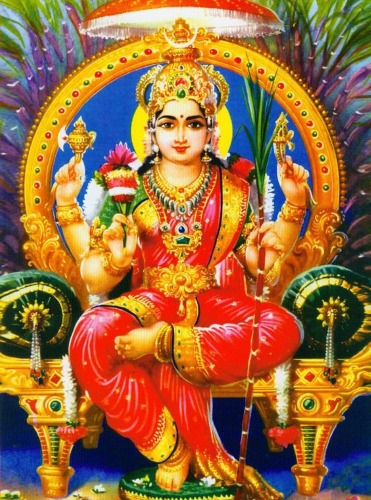
In this 44thverse, Śrī Lalitā appears as:
The transcendent, absolute, formless Supreme Reality, beyond all attributes and limitations.
She is:
- Pure (nirmalā) and untouched (nirlēpā) by anything in creation
- Eternal (nityā) and formless (nirākārā)
- Unagitated and serene (nirākulā, śāntā)
- Beyond all qualities (nirguṇā)
- Whole, partless, and indivisible (niṣkalā)
- Free from desire (niṣkāmā)
- Undisturbed by time or change (nirupaplavā)
In this verse, Lalitā is not merely the personal Mother but the Nirguṇa Brahman, the infinite Consciousness from which everything arises and into which everything dissolves.
Meditation:
This verse brings the seeker from devotion to pure awareness, reminding us that the Divine Mother is ultimately the silent, boundless Consciousness within.
When we meditate on these names, we touch the truth that:
- Purity is our nature (nirmalā).
- Peace is our essence (śāntā).
- Desirelessness is freedom (niṣkāmā).
- Formlessness is our deepest identity (nirākārā).
Lalitā here invites the devotee to rest in inner stillness, beyond agitation, beyond qualities, beyond desires. This is the Mother as the eternal witness, the unshakable peace present behind all forms and experiences.
Meditating on this verse dissolves the ego and awakens the truth:
The Mother and the Self are One—pure, eternal, and infinite.
Sanskrit: निर्लेपा
Tamil: நிர்லேபா
Meaning: She who remains completely untouched by impurities, unaffected by the world’s dualities, even while sustaining the entire universe. Nirlepā symbolizes absolute purity — engagement without attachment.
Reflection: As Nirlepā, She acts through creation yet remains ever free. She reminds us that purity is not running away from life but moving through life without letting its dust cling to the heart. Her presence teaches us how to face challenges without absorbing negativity.
Contemporary Reflection: In daily life, Nirlepā teaches: • be present, but not overwhelmed • help others, but don’t drown in their problems • do your duty, but don’t lose your peace • listen with compassion, but don’t let negativity stick She inspires clarity in action and freedom in mind — the ability to live in the world without letting the world live inside us.
Meditation: “I honor Nirlepā, the untouched and ever-pure Mother, who teaches me to act with compassion while remaining inwardly free and serene.”
Sanskrit: निर्मला
Tamil: நிர்மலா
Meaning: She who is immaculate and radiant—pure like untouched light. As Nirmalā, She represents the Divine Mother as spotless consciousness, untouched by ignorance or stain.
Reflection: As Nirmalā, She reflects absolute clarity. Her nature is serene, unclouded, transparent. Meditating on Her cleanses the mind of judgment, bitterness, false impressions, and emotional impurities.
Contemporary Reflection: In a world of misunderstandings and quick judgments, Nirmalā reminds us to: • keep our mind clear, • keep our words honest and kind, • keep our heart free from resentment, • and live with sincerity. Her grace restores lost respect, dissolves unfair blame, and brings back dignity where it was taken away.
Meditation: “I bow to Nirmalā, the pure and radiant Mother, who removes all blame, restores honor, and fills my heart with clarity and sincerity.”
Sanskrit: नित्या
Tamil: நித்யா
Meaning: She who is eternal, unchanging, and beyond time. As Nityā, She is the timeless essence from which creation flows and into which it returns. She witnesses all changes but remains untouched by them.
Reflection: As Nityā, She reveals the dimension of pure consciousness — the part of us that never ages, never decays, and never dies. She is the still center of the turning universe, the unchanging truth behind life’s constant motion.
Contemporary Reflection: She teaches us that while the body ages and life fluctuates, the soul is timeless. She helps us trust the inner voice that guides our path, resolves long-standing issues, and provides strength for lifelong well-being. Her grace brings longevity, fearlessness, and the ability to navigate life with clarity.
Meditation: “I honor Nityā, the eternal Mother who guides my path, protects my children, and anchors my soul in timeless truth.”
Sanskrit: निराकारा
Tamil: நிராகாரா
Meaning: She who is formless, transcending all physical shapes and attributes.
Reflection: As Nirākārā, She is the eternal, immeasurable Reality that cannot be confined to any image. She reveals that the Divine is not merely what is visible, but the subtle presence that holds the universe together.
Contemporary Reflection: Her presence brings deep calm, especially to minds troubled by fear, anxiety, or disturbed sleep. To those who feel affected by unseen energies, She becomes a shield of pure awareness, restoring peace and emotional stability.
Meditation: “I bow to Nirākārā, the formless Mother whose subtle presence removes fear, restores rest, and fills my mind with silent peace.”
Sanskrit: निराकुला
Tamil: நிராகுலா
Meaning: She who is free from agitation and confusion, ever serene and composed.
Reflection: As Nirākulā, She shows us that peace is not the absence of activity, but the absence of disturbance within. Her presence dissolves mental clutter, fear, and hesitation, allowing us to approach challenges with calm clarity.
Contemporary Reflection: In times of stress, pressure, or big decisions, She teaches us to remain centered, breathe, and trust. She assures us: • Your path will become clear. • Your event will succeed. • Your opportunities will come. • Your mind will find quietness. Her grace stabilizes the mind and aligns circumstances in our favor.
Meditation: “I honor Nirākulā, the serene Mother who clears my confusion, calms my heart, and guides me toward success and clarity.”
Sanskrit: निर्गुणा
Tamil: நிர்கு³ணா
Meaning: She who is beyond all attributes, forms, and limitations.
Reflection: As Nirguṇā, She teaches that the Divine is not defined by characteristics but experienced as pure presence. She transforms the seeker not by force, but through grace — softening tendencies, refining behavior, and purifying nature.
Contemporary Reflection: She reminds us that true worth is not based on: • personality, • labels, • achievements, or • others’ opinions. Her grace helps us: • rise above ego and reactions, • resolve conflicts with understanding, • bring harmony into family relationships, • and cultivate acceptance and patience. Where there is division, Nirguṇā brings unity. Where there is resistance, She brings softness.
Meditation: “I bow to Nirguṇā, the limitless Mother beyond all qualities, who transforms my nature through grace and fills my home with unity and peace.”
Sanskrit: निष्कला
Tamil: நிஷ்களா
Meaning: She who is indivisible and whole — beyond parts, divisions, and limitations.
Reflection: As Niṣkalā, She reveals the state of perfect unity: where nothing is missing, nothing is divided, and nothing is incomplete. She is the source through which all forms manifest and into which they return as oneness.
Contemporary Reflection: Niṣkalā grace restores: • lost confidence, • faded abilities, • broken harmony, • and disconnected relationships. Where we feel fragmented, She makes us whole again.
Meditation: “I honor Niṣkalā, the undivided Mother of completeness, who restores what is lost, unites what is scattered, and reveals the oneness within all.”
Sanskrit: शान्ता
Tamil: ஶாந்தா
Meaning: She who is the very embodiment of peace — serene, still, and deeply composed. As Śāntā, She represents the highest tranquility, the quiet presence that dissolves unrest and brings unshakable calm.
Reflection: As Śāntā, She is not just peaceful — She is Peace itself. Her presence soothes agitation, calms the heart, and removes inner storms. She is the silence that remains when fear, worry, and noise fade away.
Contemporary Reflection: In a world filled with tension, noise, and speed, Śāntā teaches us to: • slow down, • breathe, • return to stillness, • and rest in the present moment. Her peace is not passive — it is strength refined into serenity, and it naturally brings harmony, clarity, and even material well-being (porulvalam).
Meditation: “I bow to Śāntā, the embodiment of peace and supreme stillness, whose presence calms my mind and brings harmony and abundance into my life.”
Sanskrit: निष्कामा
Tamil: நிஷ்காமா
Meaning: She who is free from all desire — acting with perfect purity, untouched by longing, expectation, or attachment.
Reflection: As Niṣkāmā, She teaches that real strength is not the suppression of desire but the transcendence of it. Her actions are pure because they arise from compassion, not from wanting. She shows us that detachment brings clarity, and clarity brings truth.
Contemporary Reflection: In daily life, Niṣkāmā reminds us: • Create out of joy, not insecurity • Act with purpose, not greed • Love without expectation • Offer without counting returns When desires are aligned with dharma, they become fulfilling rather than binding. Her grace helps us experience joy without addiction, success without arrogance, and desire without suffering.
Meditation: “I honor Niṣkāmā, the desireless Mother, who frees me from craving, fulfills my rightful desires, and guides me to act with pure intention.”
Sanskrit: निरुपप्लवा
Tamil: நிருபப்லவா
Meaning: She who is unshaken, indestructible, untouched by decay or disruption. As Nirupaplavā, She is the eternal ground of stability — the unchanging Reality beneath all change.
Reflection: As Nirupaplavā, She stands firm even as worlds arise and dissolve. Her nature reveals the truth that the body may perish, but the soul never dies. She connects the seeker to the immortality of pure consciousness.
Contemporary Reflection: In today’s uncertain world, She teaches us to stay steady, composed, and value-centered, no matter how turbulent circumstances become. Her presence strengthens resolve, removes obstacles, and dissolves burdens — mental, emotional, and karmic. She gives inner stability, freedom from fear of loss, and clarity beyond confusion.
Meditation: “I bow to Nirupaplavā, the unshaken and eternal Mother, who lifts me from turmoil, removes burdens, and anchors me in the strength of my own immortal soul.”
Audio courtesy of The Sanskrit Channel
Video courtesy of Sri Sankara TV YouTube channel