38
Sanskrit:
मूलाधारैकनिलया ब्रह्मग्रन्थिविभेदिनी ।
मणिपूरान्तरुदिता विष्णुग्रन्थिविभेदिनी ॥ ३८ ॥
English:
mūlādhāraikanilayā brahmagranthivibhēdinī |
maṇipūrāntaruditā viṣṇugranthivibhēdinī ॥ 38 ॥
Tamil:
மூலாதா⁴ரைகநிலயா ப்³ரஹ்மக்³ரந்தி²விபே⁴தி³நீ ।
மணிபூராந்தருதி³தா விஷ்ணுக்³ரந்தி²விபே⁴தி³நீ ॥ 38 ॥
Meaning:
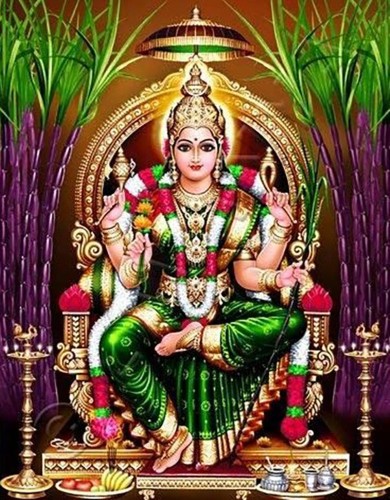
In this 38th verse, Śrī Lalitā appears as:
The Kuṇḍalinī Śakti, the ascending current of divine energy that awakens, purifies, and liberates the seeker by piercing the three granthis (spiritual knots) that bind consciousness.
- At the Svādhiṣṭhāna, She manifests as Brahmagrānthi-vibhedinī, breaking the knot tied by Brahmā at birth — the bond of material identity and worldly attachment — releasing the dormant energy of creation.
- At the Maṇipūra–Anāhata, She rises as Viṣṇu-grānthi-vibhedinī, cutting through emotional and mental attachments spread across past, present, and future (vāsanā mālam). In this form, She appears as Mōhinī or Mahā Viṣṇu, granting mastery over the mind (manam) and dissolving habitual desires and restlessness.
- Thus, She is the Liberating Power who guides the aspirant step by step — from the awakening of the root energy to the purification of the heart — leading toward higher consciousness and inner freedom.
Meditation:
This verse invites us to internalize the Divine Mother as Kuṇḍalinī, the sacred energy within our own being. The granthis symbolize inner limitations:
- Brahma-granthi – identification with body and material life.
- Viṣṇu-granthi – attachments of mind, emotions, and relationships.
As Śakti rises, these knots dissolve, leading us toward spiritual freedom and clarity. Meditation on this verse awakens devotion and the courage to let go of limiting attachments, allowing the Mother’s grace to carry us toward Self-realization.
Sanskrit: मूलाधारैक-निलया
Tamil: மூலாதா⁴ரைக-னிலயா
Meaning: She who abides as the sole divine power in the Mūlādhāra Chakra, the root energy center at the base of the spine—where Mahā Gaṇapati resides, with Siddha Lakṣmī on His right and Vallabhāma on His left, seated upon a four-petaled lotus. Worshipping Her in this form removes obstacles and awakens the dormant spiritual energy (Kuṇḍalinī Śakti).
Reflection: The Mother as Mūlādhāraika-nilayā reminds us that every spiritual ascent begins with grounding—stability, purity, and the removal of inner blockages. When the root is strong, the entire spiritual structure can rise in balance and grace.
Contemporary Reflection: She teaches us to remain centered amidst challenges. Like the root that anchors a tree, inner stability nurtures outer growth—helping us stay calm, resilient, and spiritually aligned in all aspects of life.
Meditation: “I meditate on the Mother who dwells in the root center, the source of strength, stability, and awakening.”
Sanskrit: ब्रह्मग्रन्थि-विभेदिनी
Tamil: ப்³ரஹ்மக்³ரந்தி²-விபே⁴தி³னீ
Meaning: She who pierces the Brahma-granthi, the first spiritual knot associated with the Svādhiṣṭhāna Chakra, visualized as a six-petalled lotus where Brahmā, Gayatrī, and Sāvitrī are worshipped. This knot, symbolically tied by Brahmā at the time of birth, binds the soul to the physical plane through attachment, desire, and ego. As Brahmagrānthi-vibhedinī, the Divine Mother unties this primal bond, allowing Kundalinī Śakti to awaken and rise upward.
Reflection: When this knot is pierced by Her grace, the seeker is freed from the weight of material conditioning and begins to experience life with spiritual clarity, devotion, and inner joy. It marks the first step in liberation, where consciousness shifts from survival to awakening.
Contemporary Reflection: She reminds us that our limitations are not permanent — with awareness, discipline, and grace, we can release inherited patterns and emotional knots to rediscover the boundless power within.
Meditation: “I bow to the Mother who dissolves the knot tied at birth, awakening divine energy and guiding the soul toward freedom.”
Sanskrit: मणिपूरान्त-रुदिता
Tamil: மணிபூராந்த-ருதி³தா
Meaning: She who has transcended the Maṇipūra Chakra, the ten-petalled lotus at the navel where Mahā Viṣṇu resides with Śrīdevi and Bhūdevi, representing sustenance, harmony, and divine balance. In the path of Samayācāra (inner realization), She is worshipped here as the subtle fire of transformation, guiding the seeker beyond the realm of form (Rūpa Siddhi) toward the formless truth.
Reflection: The Mother as Maṇipūrāntaruditā leads the spiritual energy upward from the center of will and vitality toward the heart of devotion. She transforms ambition into purpose and personal power into divine service.
Contemporary Reflection: She teaches us to rise above the ego’s urge for control and recognition, turning energy into compassion, and confidence into surrender — where strength becomes grace.
Meditation: “I bow to the Mother who transcends the navel lotus, transforming power into purity and will into divine harmony.”
Sanskrit: विष्णु-ग्रन्थि-विभेदिनी
Tamil: விஷ்ணு-க்³ரந்தி²-விபே⁴தி³னீ
Meaning: She who severs the Viṣṇu Granthi, the spiritual knot at the Anāhata Chakra (heart center). This knot binds the soul through attachments, emotions, and desires that flow across past, present, and future — the chain of vāsanā (deep-rooted tendencies) and habitual patterns (mālam). In the inner path, She manifests as Mōhinī or Mahā Viṣṇu, granting mastery over the mind (manam) and dissolving the pull of worldly longings.
Reflection: As Viṣṇu-grānthi-vibhedinī, the Divine Mother releases the seeker from emotional bondage, transforming restlessness into peace, and desire into devotion. When the mind is brought under control, one becomes anchored in divine love and self-awareness.
Contemporary Reflection: She teaches us that real mastery lies not in controlling the outer world, but the inner mind. By praying to Her, the restless heart becomes calm, bad habits lose their hold, and love flows freely without fear or attachment.
Meditation: “I bow to the Mother who dissolves the heart’s knots, freeing the mind from habits and desires, awakening divine peace within.”
Audio courtesy of The Sanskrit Channel
Video courtesy of Sri Sankara TV YouTube channel