34
Sanskrit:
हरनेत्राग्निसन्दग्धकामसञ्जीवनौषधिः ।
श्रीमद्वाग्भवकूटैकस्वरूपमुखपङ्कजा ॥ ३४ ॥
English:
haranētrāgnisandagdhakāmasañjīvanauṣadhiḥ |
śrīmadvāgbhavakūṭaikasvarūpamukhapaṅkajā ॥ 34 ॥
Tamil:
ஹரநேத்ராக்³நிஸந்த³க்³த⁴காமஸஞ்ஜீவநௌஷதி⁴꞉ ।
ஶ்ரீமத்³வாக்³ப⁴வகூடைகஸ்வரூபமுக²பங்கஜா ॥ 34 ॥
Meaning:
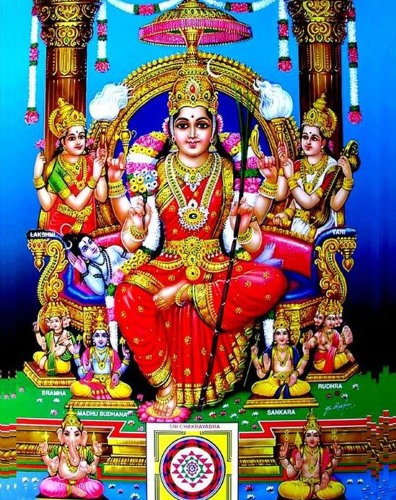
In this 34th verse, Śrī Lalitā appears as:
The life-giving power who revives Kāmadeva after he was reduced to ashes by Śiva’s third-eye fire. Her lotus-face embodies the Vāgbhava-kūṭa—the speech/knowledge aspect of the Śrī Vidyā Mantra—making Her the very source of divine wisdom, sweetness, and expression.
Here, Lalitā is both the restorer of life and love and the embodiment of sacred knowledge, showing that creation, preservation, and enlightenment all arise through Her grace.
Meditation:
This verse teaches us that the Divine Mother not only destroys but also restores and transforms. The revival of Kāma symbolizes the return of love and desire—but now sanctified, made divine, directed toward higher consciousness rather than worldly bondage.
Her face as the Vāgbhava-kūṭa reminds us that divine speech and wisdom flow from Her. Meditating on this verse invites us to let our words, desires, and actions be refined by Her grace—so that what was once impulsive or destructive within us can be reborn as love, creativity, and spiritual aspiration.
Sanskrit: हरनेत्राग्नि-सन्दग्ध-कामसंजीवनौषधीः
Tamil: ஹரனேத்ராக்³னி-ஸந்த³க்³த⁴-காமஸஞ்ஜீவனௌஷதி⁴꞉
Meaning: She who is the divine power and life-giving force that revived Kāmadeva (the god of love) after he was burned to ashes by the fire from Lord Śiva’s third eye.
Reflection: Her energy signifies that love and life can be renewed even after total destruction. She transforms pain into hope and vitality, showing the eternal nature of divine compassion.
Contemporary Reflection: Even when life burns us with challenges or loss, the healing power of grace can rekindle our spirit. This name inspires us to believe in new beginnings and the revival of love and purpose after adversity.
Meditation: “I meditate on the Mother who heals burnt hearts and brings back life where there was none.”
Sanskrit: श्रीमद्वाग्भव-कूटैक-स्वरूप-मुख-पङ्कजा
Tamil: ஶ்ரீமத்³வாக்³ப⁴வ-கூடைக-ஸ்வரூப-முக²-பங்கஜா
Meaning: She whose face, like a lotus, represents the Vāgbhava-kūṭa — the first section of the Pañcadaśī Mantra, symbolizing speech, wisdom, and divine expression. Her lotus-face radiates beauty, knowledge, and benevolence.
Reflection: The Mother’s face shines like the dawn of wisdom, inspiring clarity in thought, speech, and action. She embodies the union of beauty and knowledge.
Contemporary Reflection: Our words carry the power to heal or harm, enlighten or confuse. This name reminds us to speak truth with kindness, reflecting the divine clarity and grace she symbolizes.
Meditation: “May my words and expressions reflect the serene wisdom of her lotus-like face.”
Audio courtesy of The Sanskrit Channel
Video courtesy of Sri Sankara TV YouTube channel