30
Sanskrit:
विशुक्रप्राणहरणवाराहीवीर्यनन्दिता ।
कामेश्वरमुखालोककल्पितश्रीगणेश्वरा ॥ ३० ॥
English:
viśukraprāṇaharaṇavārāhīvīryananditā |
kāmēśvaramukhālōkakalpitaśrīgaṇēśvarā ॥ 30 ॥
Tamil:
விஶுக்ரப்ராணஹரணவாராஹீவீர்யநந்தி³தா ।
காமேஶ்வரமுகா²லோககல்பிதஶ்ரீக³ணேஶ்வரா ॥ 30 ॥
Meaning:
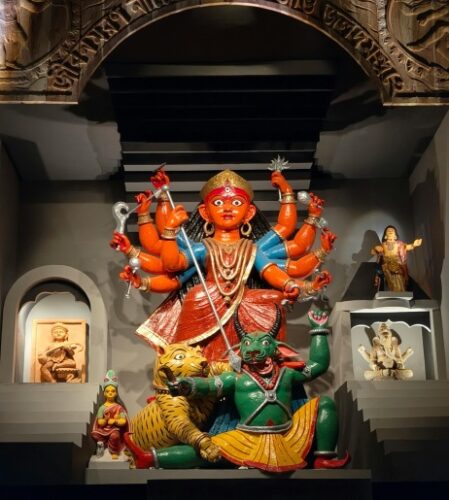
In this 30th verse, Śrī Lalitā appears as:
The Mother of the Universe who rejoices in the victory of Her commander Vārāhī, who slays the demon Viśukra with great might. At the same time, She is the Supreme Source from whom Śrī Gaṇeśa Himself is manifested—born from the glance of Śrī Kāmēśvara for the sole purpose of destroying the obstacles and yantras created by Bhaṇḍāsura.
Thus, Lalitā is revealed both as the commander who empowers Her śaktis (Vārāhī) and as the divine creatrix who brings forth Gaṇeśa, the remover of obstacles.
Meditation:
This verse beautifully balances Lalitā’s two dimensions:
- On one side, She is the Supreme General, rejoicing in the valor of Her devotee-warrior Vārāhī, who annihilates evil (Viśukra).
- On the other side, She is the Universal Mother, through whose union with Kāmēśvara emerges Gaṇeśa, the remover of obstacles.
In meditation, the sādhaka sees that all victories in life—whether over inner demons of ignorance, ego, and desire, or outer struggles—are Hers alone. At the same time, She reassures us by manifesting as Gaṇeśa, the ever-auspicious son who clears our path. 💫 Thus, Lalitā is both the source of might and the fountain of grace.
Sanskrit: विशुक्र-प्राणहरण-वाराही-वीर्य-नन्दिता
Tamil: விஶுக்ர-ப்ராணஹரண-வாராஹீ-வீர்ய-நந்தி³தா
Meaning: She who rejoices (Nanditā) in the valor (Vīrya) of Vārāhī Devī (the commander of Śrī Lalitā’s army) when she slew Viśukra, the other brother of Bhaṇḍāsura. After Viśaṅga’s destruction by Mantriṇī, the killing of Viśukra symbolizes the Mother’s army completely removing evil forces.
Reflection: This name shows the power of divine delegation—the Supreme Mother empowers Her Śaktis (like Vārāhī) to carry out Her will. Their victories are not separate, but part of Her own triumph.
Contemporary Reflection: In life, true leadership means trusting and empowering others. When we enable our team, family, or community to act with strength, their success becomes our shared joy.
Meditation: “May I learn to empower others, and rejoice in their victories as my own.”
Sanskrit: कामेश्वर-मुखालोक-कल्पित-श्रीगणेश्वरा
Tamil: காமேஶ்வர-முகா²லோக-கல்பித-ஶ்ரீக³ணேஶ்வரா
Meaning: She who, by merely casting Her glance towards Kāmeśvara’s face, brought forth Śrī Gaṇeśa. This highlights the effortless creative power of the Divine Couple — from a single exchange of glance, the remover of obstacles, Gaṇapati, was manifested.
Reflection: This shows that creation itself arises not from effort, but from the union of pure consciousness and pure energy. Even a gentle look between Śiva (Kāmeśvara) and Śakti (Lalitā) is enough to give birth to divine forms that sustain dharma.
Contemporary Reflection: Sometimes, the most powerful outcomes come not from hard struggle, but from a moment of alignment and harmony. When intention and energy are in balance, things manifest naturally.
Meditation: “May my actions flow with such harmony, that even the smallest glance of love brings forth great blessings.”
Audio courtesy of The Sanskrit Channel
Video courtesy of Sri Sankara TV YouTube channel